
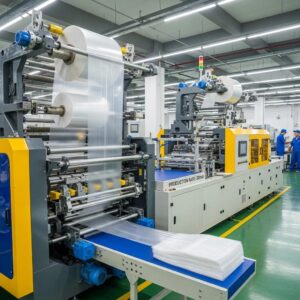
Plastic Bag Making Machines for Sale in Pretoria
Plastic Bag Making M
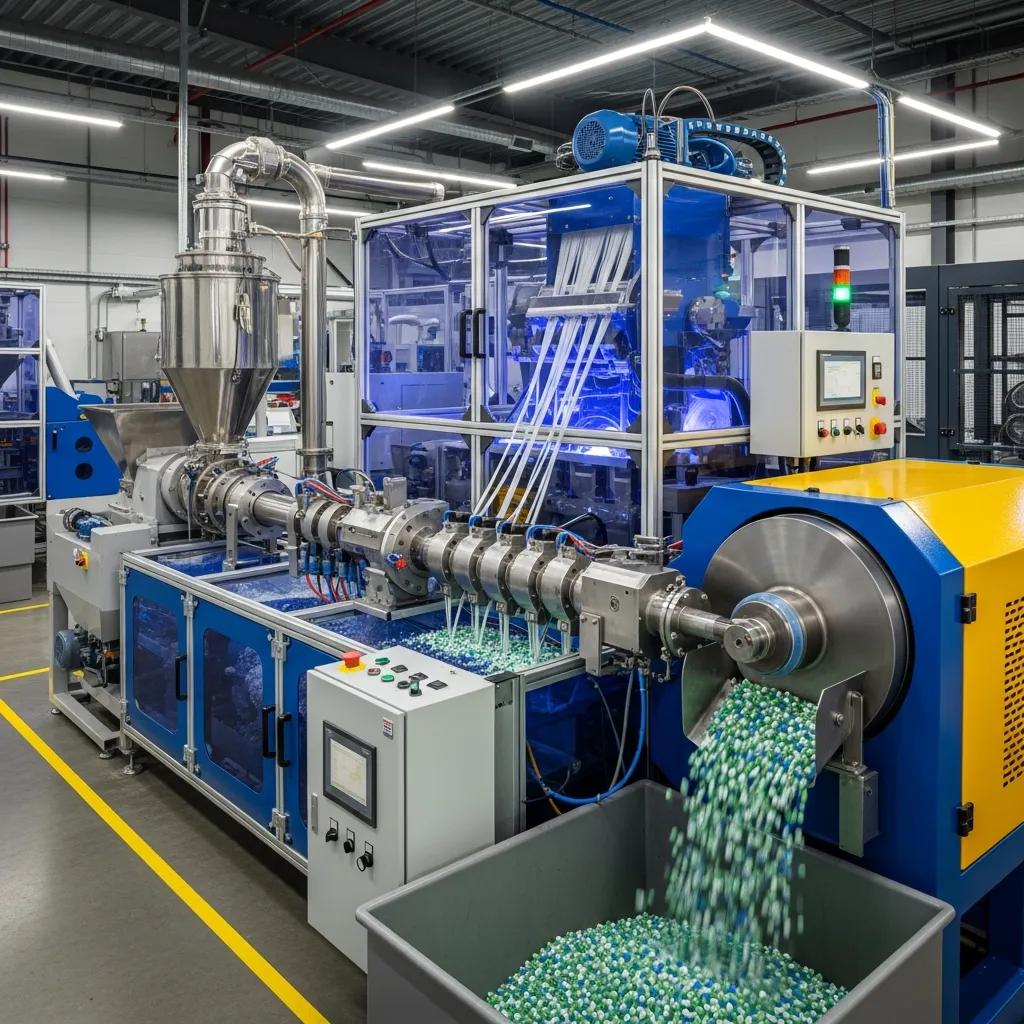
Plastic pelletizing machines turn post-consumer and industrial plastic waste into uniform pellets that can be reintroduced as feedstock for manufacturing, reducing raw-material costs and landfill burden. This guide explains how pelletizers work, compares common pelletizer types, and maps the end-to-end plastic pelletizing process flow so South African recyclers and manufacturers can evaluate options effectively. You will learn material-specific recommendations for PP, PE, HDPE, and PET, the operational trade-offs that affect pellet quality and throughput, and practical selection and maintenance advice to maximise uptime and ROI. The article also describes integration points with blown film extrusion and flexo printing lines so readers understand closed-loop recycling benefits. Along the way we reference a qualified supplier, Plastic Bag Machine South Africa (Kingdom Machinery Co., Ltd.), only to illustrate available service and product support for buyers preparing plant setups. By the end you will have clear steps to choose an energy efficient plastic pelletizer, design a reliable pelletizing process, and assess procurement priorities for the South African market.
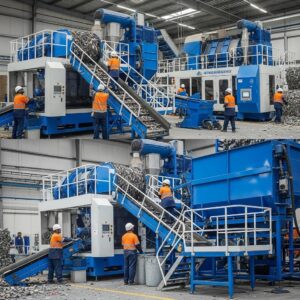
Plastic pelletizing machines are specialised recycling equipment that convert shredded or molten plastic into uniform granules or pellets, enabling reuse in manufacturing and reducing dependency on virgin resin. They work by melting cleaned plastic material through an extruder, forcing it through a die head, and cutting the extrudate into pellets which are cooled and sized for consistent downstream processing. The core benefits include material recovery, predictable pellet quality for extrusion or molding, and lower per-kilogram feedstock costs for manufacturers. Efficient pelletizers therefore form the central link in a plastic recycling plant, supporting both sustainability goals and operational savings for businesses.
Plastic Bag Machine South Africa (Kingdom Machinery Co., Ltd.) supplies production lines and pelletizing solutions designed for straightforward operation, simple maintenance, and timely after-sales support. Their stated strengths include cost-effective machinery, 100% final inspection, strong R&D, and a one-stop service approach from innovation to mass production. Mentioning a supplier early helps buyers identify practical partners for system-level design and specification queries. Prospective purchasers should evaluate these supplier capabilities alongside technical machine attributes when planning a recycling installation.
A pelletizer converts prepared plastic into pellets through a sequence of feeding, melting, filtering, extruding, cutting, cooling, and sizing operations, creating a consistent product for reuse. Feedstock first passes through shredders and dryers before entering the extruder, where temperature-controlled screws melt and homogenise the polymer while degassing modules remove volatiles that affect pellet quality. The molten strand or underwater cut system produces discrete pellets which are immediately cooled—either in air, water-ring, or underwater systems—to set polymer crystallinity and minimize deformation. Quality control relies on screen packs, melt filters, and inline sieving to maintain particle uniformity and to prevent contaminants from compromising downstream processes.
This mechanical and thermal chain determines final pellet properties like bulk density, melt flow index, and surface finish, which in turn influence reprocessing performance. Understanding each step helps operators select the correct pelletizing approach for target applications. The next subsection lists the main machine types available and their typical use cases, enabling a quick match between material and pelletizer architecture.
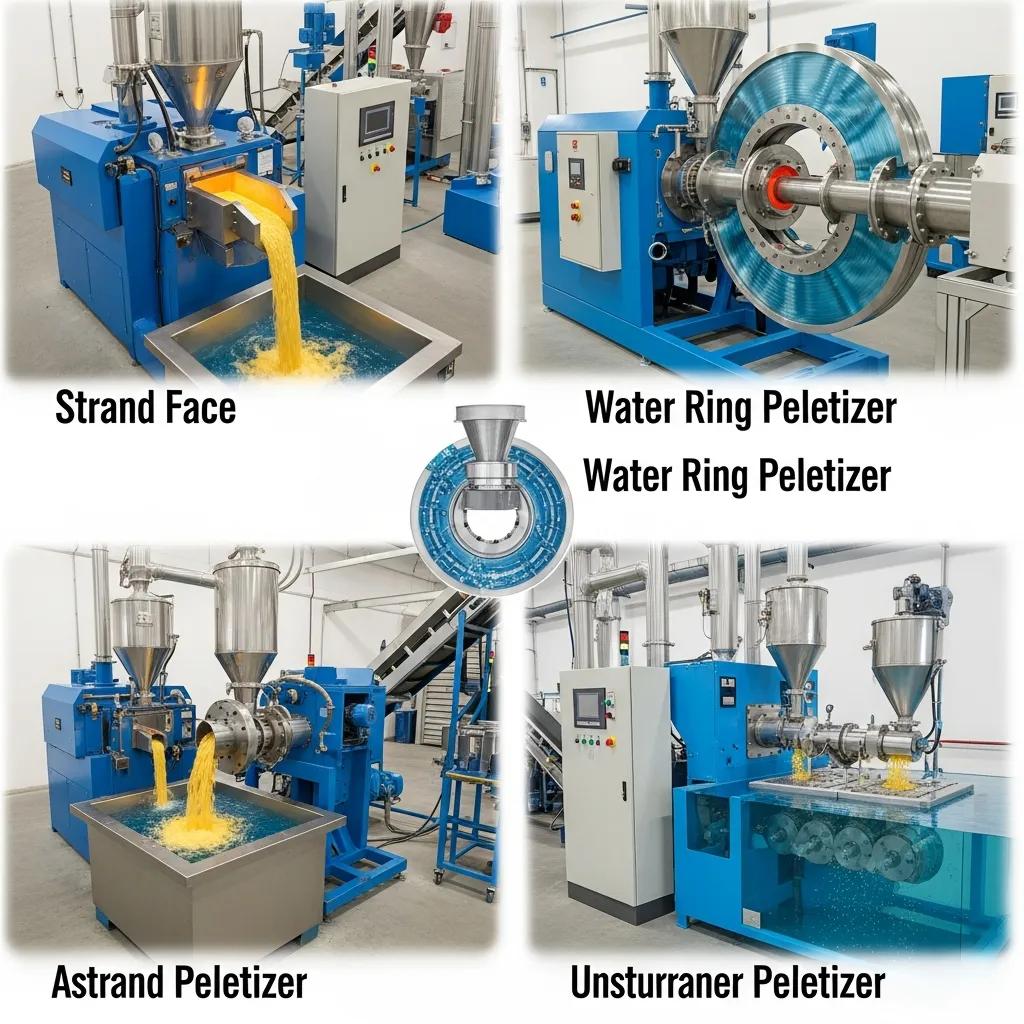
Common pelletizer types include strand pelletizers, water-ring pelletizers, underwater pelletizers, and cutter compactor pelletizers, each tailored to different feedstocks and throughput requirements. Strand pelletizers cut extruded strands in air then tumble and dry the pellets, offering simplicity and lower capital cost for clean, low-moisture polymers used in rigid applications. Water-ring and underwater pelletizers cut molten strands into a water bath for immediate cooling and dust suppression, producing attractive pellets for film and applications requiring better appearance. Cutter compactor (also called granulation) units combine compression and cutting and are useful for reclaiming wet or contaminated film scraps where direct granulation is faster.
Choosing between these types requires balancing pellet quality, energy consumption, maintenance, and required footprint to meet production goals and polymer characteristics. The next major section outlines specific recommendations by material, including PET and film-grade HDPE, to guide equipment selection.
Matching pelletizer type to polymer and waste form ensures the best pellet quality and operational efficiency for a given recycling stream. Different materials present distinct challenges—film tends to be low bulk density and dirty, rigid grades require higher melt homogeneity, and PET demands strict moisture control—so choosing the right pelletizer reduces rejects and maximises throughput. Below is a structured comparison to help you weigh feedstock compatibility, throughput ranges, pellet quality, and energy implications when selecting a machine.
This table summarises common pelletizer types against practical attributes relevant to South African recyclers.
| Pelletizer Type | Feedstock Compatibility | Typical Throughput (kg/h) |
|---|---|---|
| Strand Pelletizer | Clean, dry rigid plastics (PP, PE, HDPE) | 100–800 |
| Water-ring Pelletizer | Film, mixed streams needing dust control | 200–1000 |
| Underwater Pelletizer | High-throughput, compact lines for PE/PP | 500–2500 |
The comparison highlights that strand systems suit lower-throughput, cleaner feedstocks while underwater units scale for larger operations where floor space and high output matter. Always assess contamination levels and moisture content before final selection because those factors drive additional pre-treatment needs and influence operational cost.
Strand, water-ring, and underwater pelletizers each offer trade-offs in maintenance, pellet appearance, and energy use that affect plant economics and product fit. Strand pelletizers are mechanically simple with lower initial cost and easier maintenance, making them suitable for processors on modest budgets who recycle clean rigid scraps. Water-ring pelletizers improve pellet shape and reduce dust, which benefits appearance-sensitive film applications but require water handling and drying systems. Underwater pelletizers deliver the highest throughput and compact footprint for large-scale operations, though they have more complex hydraulics and higher energy intensity.
Understanding these trade-offs helps managers prioritise what matters—appearance, throughput, energy use, or simplicity—so they can select a pelletizer that aligns with both product quality targets and operating capabilities. The following subsection explains how to match pelletizers to specific polymers like PET and HDPE.
Selecting the correct pelletizer requires assessing polymer properties and pre-treatment needs, since PET and hygroscopic polymers are sensitive to moisture while film recyclates often need aggressive washing. For PET recycling, prioritise a system with effective drying and crystallisation control and pair with vacuum or vented extruders to prevent hydrolytic degradation. For PP and PE, strand or underwater pelletizers can be appropriate depending on contamination and throughput, whereas HDPE film typically benefits from water-ring pelletizing to improve surface finish and reduce fines.
Operators should specify desired throughput (100–1000 kg/h or higher), allowable contamination levels, and target pellet quality when requesting machine specifications. Plastic Bag Machine South Africa (Kingdom Machinery Co., Ltd.) can provide product lines that match these material-specific requirements and offer consultations to align machine specs with plant-level constraints, helping buyers request accurate technical drawings and performance data.
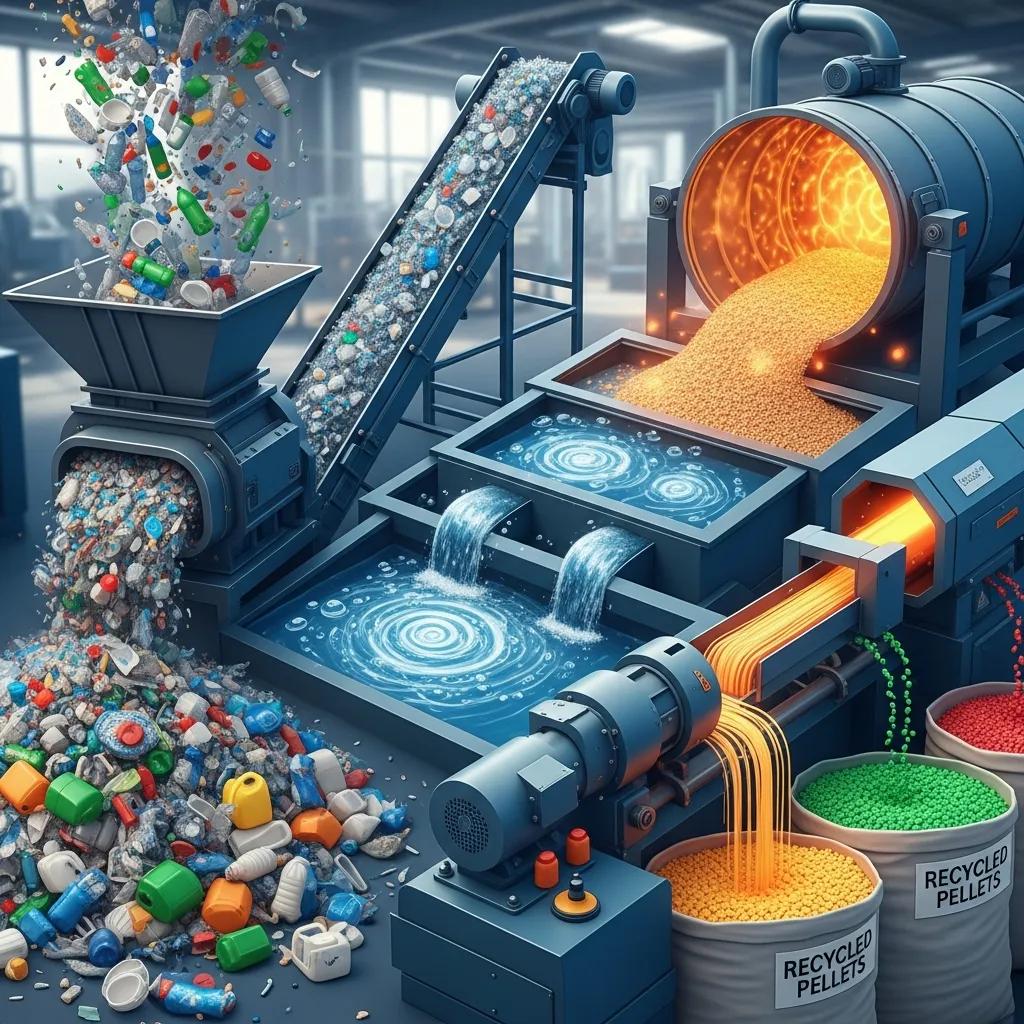
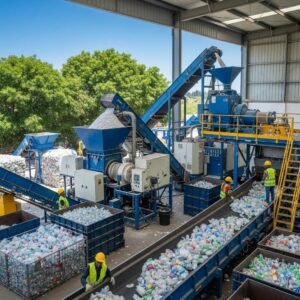
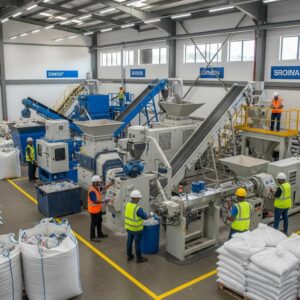
The pelletizing process converts heterogeneous waste streams into consistent pellets through a series of coordinated stages that control contamination, moisture, melt quality, and pellet sizing. A well-designed plant sequences shredding, washing, drying, extrusion, pelletizing, and packaging with inspection and sieving points to protect extruder screws and dies while producing acceptable recycled resin properties. Each stage contributes measurable quality parameters—temperature, moisture, and residence time—that determine pellet performance in downstream extrusion or molding. Mapping these stages makes it easier to spot bottlenecks, reduce energy use, and optimise material yield for South African recycling operations.
The pelletizing process follows repeatable stages that prepare, purify, melt, and form pellets ready for reuse.
This ordered flow emphasises moisture control and contamination removal as critical control points to preserve polymer properties and ensure consistent pellet quality for downstream manufacturing.
This table maps those stages to typical equipment and target parameters to guide engineering decisions.
| Process Stage | Typical Equipment | Key Parameters |
|---|---|---|
| Shredding | Industrial granulator | Particle size 10–50 mm |
| Washing | Friction washer, float-sink | Temperature 40–60°C; detergent concentration |
| Drying | Thermal / centrifugal dryer | Moisture <0.2% for PET |
| Extrusion | Single/double-screw extruder | Melt temp based on polymer, screw RPM |
| Pelletizing | Strand/underwater cutter | Cut frequency, cooling rate |
Integrating pelletizing with blown film extrusion and flexo printing enables closed-loop workflows where film scrap is returned as pellets for re-extrusion, reducing raw-material purchases and waste disposal costs. Recycled pellets fed into a blown film extrusion line must meet tight melt-flow and contamination tolerances to avoid print defects and mechanical failures in flexo printing operations. When a recycling loop is tightly controlled—through inline sieving, melt filtration, and consistent pellet sizing—manufacturers can reuse a higher fraction of in-house scrap with minimal downcycling. Operational benefits include shorter material logistics chains, predictable feedstock characteristics, and lower overall lifecycle emissions for film products.
Designing integrated lines requires coordination between pelletizer outputs and film extruder feed requirements, including moisture control, pellet size uniformity, and pellet drying schedules. The next major section outlines economic and sustainability benefits for South African businesses considering pelletizer investments.
Efficient pelletizing machines deliver measurable economic and environmental benefits by turning waste into saleable or reusable feedstock and reducing reliance on imported virgin resin. Savings arise from lower material procurement costs, reduced waste management expenditures, and potential revenue streams from selling cleaned pellets to regional converters. Environmental advantages include reduced landfill usage, lower transport-related emissions, and improved compliance with recycling mandates and corporate sustainability targets. For South African businesses facing variable resin prices and tightening regulatory attention, pelletizing provides a practical route to both cost control and reputational improvement.
These advantages combine to shorten payback periods when throughput and uptime are reliably maintained. The following sub-section quantifies key drivers and presents a conservative ROI thought process.
Pelletizing machines lower per-unit material costs by converting waste into usable pellets and by reducing landfill and transport fees associated with scrap disposal. A basic ROI approach compares avoided resin purchases plus reduced disposal costs against machine capex and operating energy, with sensitivity to throughput, contamination rates, and labour. Energy-efficient designs and optimized screw geometry reduce opex, while high first-pass yield minimises rework costs. Environmental benefits include lower greenhouse-gas intensity per produced tonne, improved compliance with extended producer responsibility expectations, and stronger sustainability claims for brands using recycled content.
Quantifying savings requires local inputs—resin spot prices, labour rates, and waste handling costs—but process design that minimises reprocessing and maximises pellet quality will consistently produce better economic outcomes. The next subsection reviews local market demand signals and how businesses can capitalise on them.
Market demand in South Africa is driven by policy initiatives, corporate sustainability commitments, and growing interest from converters seeking recycled feedstock for packaging and industrial components. Collection schemes, municipal recycling programs, and industry-led reverse logistics create streams of film and rigid plastics suitable for pelletizing, though quality and contamination variability remain practical challenges. Small- and medium-sized enterprises can capture local demand by supplying consistent pellet grades to nearby manufacturers, while larger processors can scale output to serve regional markets. Demand trends favour recyclers who can provide certification of pellet quality and traceability to support buyer confidence.
Proactive investments in pre-treatment, quality control, and consistent packaging of pellets increase marketability and reduce the time required to place recycled resin into commercial supply chains. The next main section addresses how to choose and invest in the right equipment to realise these opportunities.
Choosing and investing in industrial pelletizing equipment requires a structured procurement checklist that balances material compatibility, capacity, energy efficiency, downtime risk, and after-sales support. Critical factors include the polymer mix to be recycled, target throughput, acceptable contamination levels, available floor space, and the local availability of spare parts and service. Buyers should prioritise machines with clear inspection and testing protocols, transparent lead times, and defined warranty coverage to reduce procurement risk. Considering these attributes together yields better long-term ROI than selecting solely on initial capex.
This checklist helps procurement teams prepare targeted RFQs and evaluate total cost of ownership rather than only upfront price.
The table below compares purchase factors and how they influence capex and opex considerations.
| Purchase Factor | Impact on Cost | Decision Guidance |
|---|---|---|
| Capacity Rating | Drives capex and required footprint | Match to realistic peak throughput plus 20% buffer |
| Automation Level | Affects opex and labour | Higher automation reduces labour but increases initial cost |
| Local Support | Influences downtime and spares cost | Prioritise suppliers with local service presence |
| Energy Consumption | Ongoing operating expense | Choose energy-efficient components for lower LCOE |
Prices and ROI are shaped by machine capacity, build quality, automation, import logistics, and energy consumption, while local taxes and transport affect landed cost. Higher-capacity or highly automated machines increase capex but can shorten payback through higher throughput and lower labour needs. Conversely, simpler machines reduce initial outlay but may raise opex via manual handling and higher downtime risk. Import-related lead times and spare-parts availability also factor into a realistic ROI calculation because extended downtime can dramatically increase effective cost per produced tonne.
Decision-makers should model scenarios using conservative uptime estimates and local utility rates to understand payback periods, and seek supplier-provided test reports that corroborate throughput and energy claims. The next subsection provides a maintenance checklist that reduces unexpected failures and preserves pellet quality.
Structured maintenance schedules and straightforward troubleshooting protocols maintain pelletizer uptime and protect production quality, thereby improving return on investment. Daily checks should include visual inspection of die heads, cutter blades, and coolant flow, while weekly tasks cover screw and barrel wear measurements and filter condition. Monthly or quarterly service should perform screen-pack changes, gearbox lubrication, and alignment checks to prevent progressive failures. Rapid diagnosis of common symptoms—unusual vibration, temperature excursions, or reduced throughput—enables corrective action before a minor fault becomes a major stoppage.
A practical maintenance checklist improves operational discipline and reduces unscheduled downtime, while establishing clear criteria for when to escalate to certified service technicians versus in-house fixes. Regular preventive maintenance is a key enabler of predictable production and consistent pellet quality.
Plastic Bag Machine South Africa (Kingdom Machinery Co., Ltd.) positions itself as a one-stop supplier of plastic bag production lines and related machinery, including plastic recycling machines, blown film extrusion, and printing systems. Their stated capabilities emphasise simple operation, dependable performance, easy maintenance, and timely after-sales service—attributes buyers value when integrating pelletizers with production lines. The company reports a strong production capacity with multiple production lines and a practice of final inspection for delivered equipment, which can reduce risk for buyers seeking turnkey or modular recycling solutions.
The supplier highlights several buyer-facing features including 100% final inspection, strong R&D support, one-stop production capabilities, and a commitment to fast delivery and after-sales service—qualities that reduce procurement friction for complex recycling lines. These features translate into buyer benefits such as lower commissioning risk, access to coordinated line engineering, and faster replacement parts availability when coordinated through a single vendor. Buyers can therefore prioritise such providers when seeking integrated solutions that combine pelletizing with blown film extrusion or printing equipment.
Selecting a supplier with these capabilities streamlines communications and technical alignment across multiple machines, reducing integration errors and accelerating startup. The final subsection summarises the supplier’s track record in South Africa and suggests next steps for readers seeking quotations or references.
Reportedly, the company has installed machines across South African cities including Gqeberha, Soweto, Cape Town, and Johannesburg and has delivered more than 1,700 machines worldwide, according to available supplier information. This installation footprint and manufacturing scale illustrate experience with regional deployments and with coordinating logistics and after-sales arrangements across multiple markets. Readers evaluating suppliers may request local references, commissioning records, or demonstration videos to validate fit-for-purpose claims and to better anticipate installation timelines and service needs.
When preparing an RFQ, include required polymer types, expected throughput, contamination levels, and desired integration with downstream lines so the supplier can provide accurate performance data and inspection reports. That targeted exchange reduces ambiguity and helps both buyer and supplier agree on acceptance criteria for pellet quality and machine performance.
Plastic Bag Making M
Plastic Recycling So
Plastic Recycling So
Plastic Recycling So