
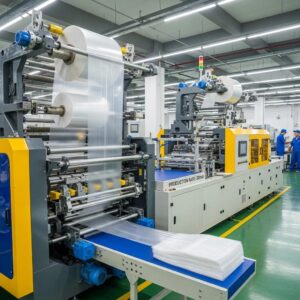
Plastic Bag Making Machines for Sale in Pretoria
Plastic Bag Making M
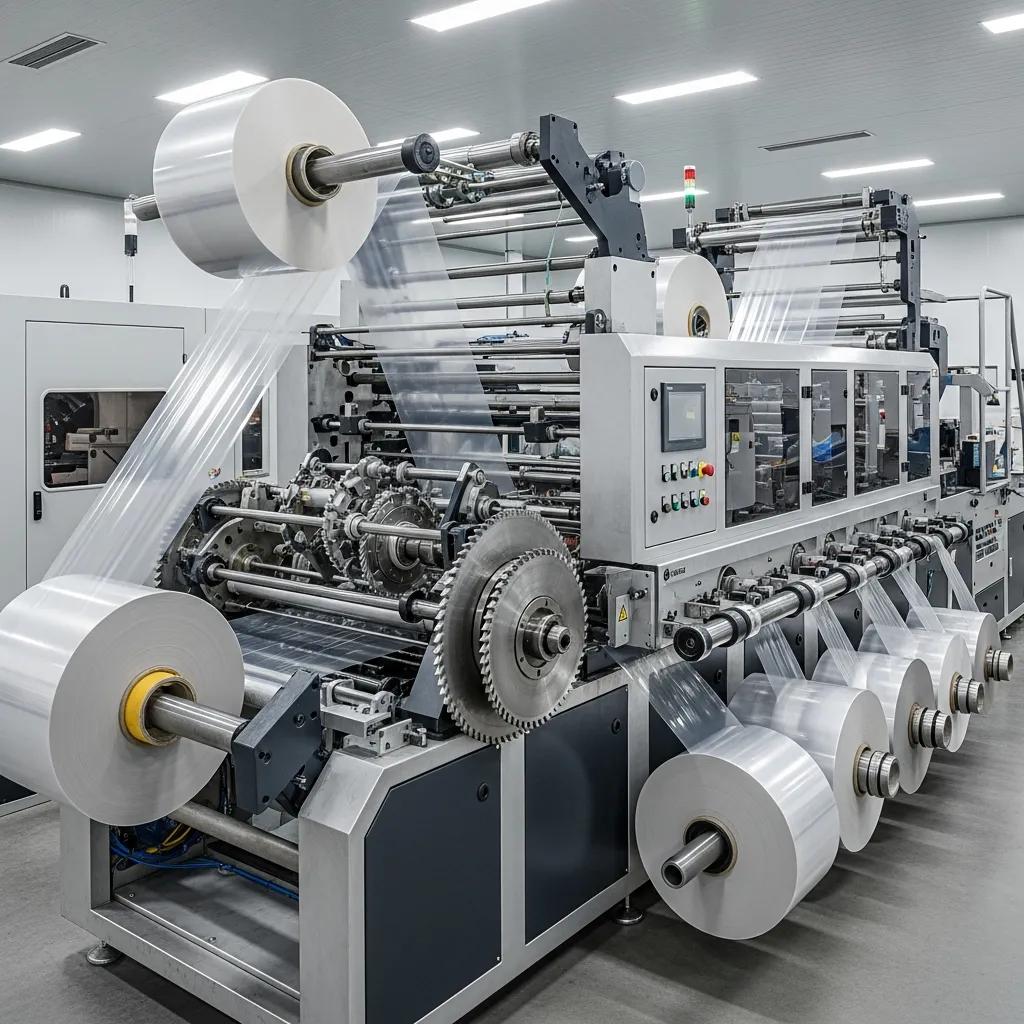
Film slitting machines convert wide master rolls of plastic film into accurately trimmed rolls suitable for printing, bag-making, laminating and other downstream converting processes in Boksburg manufacturing. This article explains what film slitting is, how machines perform unwind → slit → rewind operations, and why precision slitting reduces waste, improves downstream throughput and raises finished-product quality for converters across Ekurhuleni and greater Johannesburg. You will learn the main machine classes, key technologies (tension control, knife systems, web guiding), practical integration steps with blown film extrusion and bag-making lines, and how to match machine features to materials like BOPP, PET, PE and PVC. The guide also outlines inspection and automation checkpoints, presents comparison tables for buyers, and shows where local supply and after-sales support fit into purchasing decisions. Throughout, targeted phrases such as slitting machine Boksburg, slitter rewinder South Africa, and automatic film slitter Johannesburg are used to help engineers and procurement teams find actionable guidance.
Film slitting machines are converting equipment that unwind a large-diameter film roll, cut the web to specified widths, and rewind narrower rolls for downstream use. The mechanism uses precise tension control, knife or razor systems, and web guiding to create consistent roll diameters and edge quality, which directly reduces trim waste and changeover time. The primary benefit for Boksburg converters is predictable roll output that improves downstream operations such as flexo printing and bag making, reducing stoppages and material handling costs. Understanding these fundamentals helps manufacturers select a machine class and configuration that matches throughput, film type, and footprint constraints.
Film slitting supports efficient production by converting jumbo rolls into production-ready rolls that match press or bag machine specifications. Accurate slitting lowers off-spec product rates and stabilizes web handling, which in turn enhances print registration and bag sealing performance. The result is higher first-pass yield and lower per-unit cost, a critical outcome for competitive converters in Ekurhuleni and Johannesburg.
The following list summarizes core operational benefits that Boksburg manufacturers see from proper slitting:
These operational gains translate into lower unit costs and faster customer turnarounds, which is why many converters prioritize slitting upgrades when optimizing production lines.
Plastic Bag Machine South Africa maintains a South African-facing platform supplying slitting machines and related converting equipment to local manufacturers, positioning itself as a resource for buyers who need machines, spare parts and advice on integration. The supplier relationship can help bridge specification questions — for example, confirming knife types, motor ratings and layout constraints — while keeping the buyer-focused decision process centered on production needs.
A film slitting machine performs three coordinated tasks: unwind the master roll, slit the web to target widths, and rewind narrower rolls to specified diameters and core types. The mechanism commonly uses either shear-cut (hardened knives) or razor-cut systems, plus servo-driven rewind shafts and web guiding to maintain edge position and tension. Purpose-built for flexible packaging, slit rolls feed presses, laminators, bag machines and pouch lines, ensuring each downstream head receives the correct roll width and roll quality. In practice, slitting is essential for converting wide blown film output into supply-ready rolls for local bag production or for export-grade printed laminates.
Operational examples include trimming blown film to 300–800 mm rolls for vertical bag machines or producing narrow 25–150 mm rolls for label converters. The slitting stage therefore acts as the quality gate before printing and finishing; accurate slitting reduces waste carried forward and stabilizes overall line yield.
Understanding the tangible advantages clarifies why slitting is a key investment for Boksburg converters. Slitting machines deliver measurable improvements in throughput, quality and material utilization that directly affect production economics. Below is a focused list of the most common, buyer-relevant advantages with short explanations.
Film slitting provides these operational advantages:
These features collectively improve OEE (overall equipment effectiveness) on converting floors. By reducing variability at the slitting stage, printers and bag makers receive better-quality substrate, which increases first-pass yield and reduces manual reel handling.
Choosing the right class of slitting machine depends on throughput, material types and the downstream process. Machine classes range from basic slitter rewinders for low-to-medium volume converters to fully automatic high-speed slitters with servo drives and remote diagnostics for large-scale operations. Each class balances speed, material compatibility and footprint, so matching machine capability to the specific use case—bag making, labels, or laminated flexible packaging—is essential.
Below is a concise comparison table to help buyers evaluate machine classes on practical attributes relevant to South African plants.
Introductory note: this table compares common slitting machine classes across speed, material compatibility and typical applications to aid selection.
| Machine Class | Typical Speed Range | Typical Applications | Footprint/Cost Band |
|---|---|---|---|
| Slitter Rewinder | Low–medium (up to 200 m/min) | Bag making, small label runs | Compact / Entry–mid cost |
| Automatic Film Slitter | Medium–high (200–400 m/min) | Flexible packaging, printing | Mid footprint / Mid cost |
| High-Speed Slitter | High (400+ m/min) | Large-volume BOPP/PET lines | Larger footprint / Higher cost |
This comparison shows how throughput and material type drive machine selection; converters with mixed runs often prefer automatic slitters for flexibility, while high-volume BOPP or PET converters may invest in high-speed units for lower per-meter cost.
Overview lists of selection considerations help clarify decision drivers before deeper technical evaluation:
After assessing these items, buyers can narrow choices to the machine class that optimizes uptime and return on investment for their plant.
Slitter rewinder machines are the foundational slitting architecture: unwind the jumbo roll, pass the web through guiding and slitting stations, then rewind multiple finished rolls. Typical applications include trimming PE blown film for sack and bag machines and producing label-stock widths, where reliability and straightforward maintenance matter most. Two common mechanical approaches are center-surface (web winds on a surface roll) and center-shear (knife pair shears web for clean edges), each offering trade-offs in edge quality versus blade wear. For Boksburg converters, slitter rewinders often represent the most cost-effective way to convert extrusion output into saleable reels.
Maintenance considerations include blade sharpening schedules, rewind tension calibration and periodic bearing checks; regular preventive maintenance preserves edge quality and minimizes unplanned downtime.
Automatic and high-speed slitters add features that reduce manual setup and support continuous high-volume production. Typical automation elements include auto knife positioning, servo-driven unwind/rewind shafts, PLC recipe storage, and automatic splicing or roll changeover systems that reduce lost production time. These features enable higher throughput with consistent quality and rapid job changes, which is essential for converters running multiple SKUs per shift. When evaluating ROI, consider reduced labor per shift, lower reject rates, and higher effective uptime driven by automation.
Buyers should specifically look for robust tension control, reliable knife types for their film portfolio, and proven web guiding systems—these elements determine whether automation actually delivers consistent, profitable output.
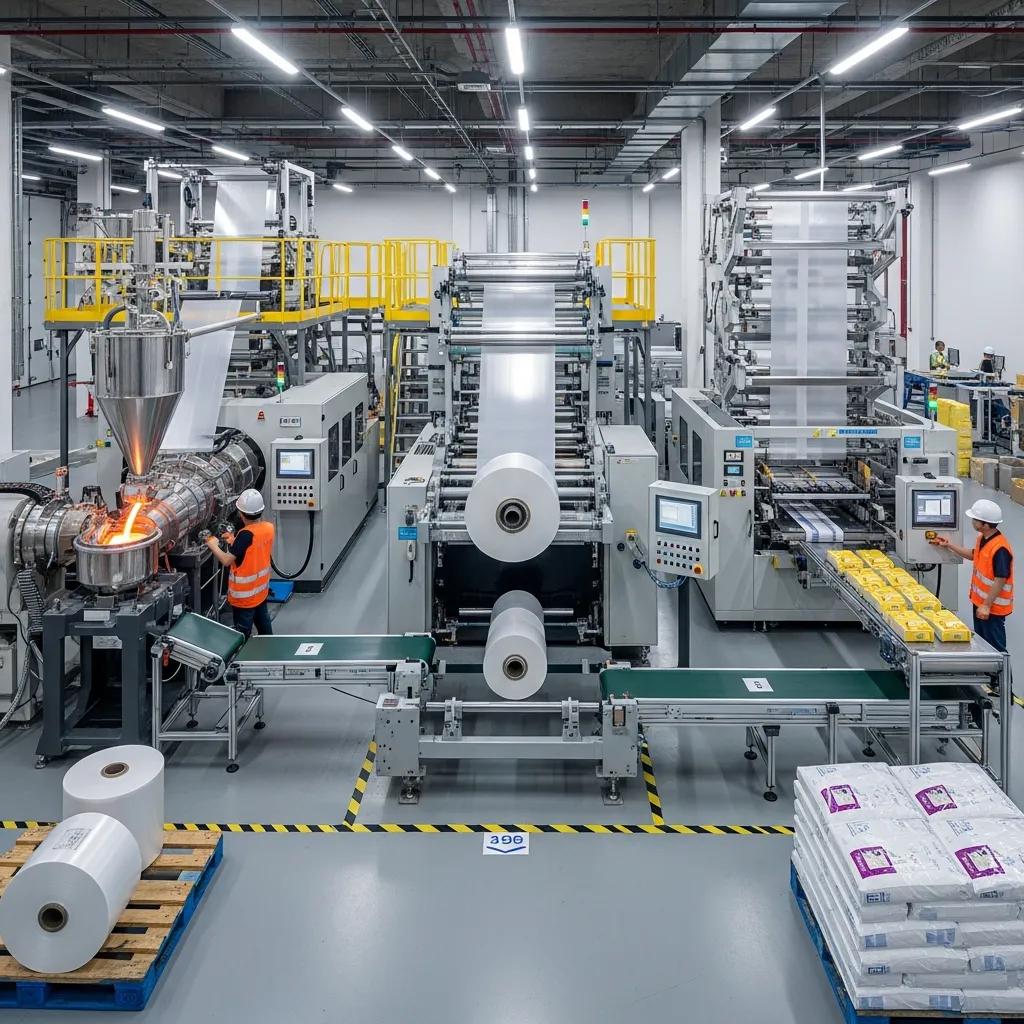
Slitting machines integrate into converting workflows as the intermediary between web production and finishing equipment: extrusion produces master rolls, slitters size the web, and bag makers or printers convert slit rolls into finished goods. Integration points focus on web handling compatibility (core diameters, roll widths), synchronized indexing or MES communication, and inline layout that minimizes handling steps. A stepwise integration view clarifies typical line architecture and decision points for layout and controls.
A simple process flow illustrates the common integration sequence:
This stepwise flow highlights that slitting is the central node that must match both upstream roll formats and downstream feed requirements; correct specification reduces forklift moves and manual splicing.
Practical integration also considers product synergies: companies supplying slitting machines often provide complementary equipment such as Blown Film Extrusion Machines, Plastic Bag Making Machines, Flexo Printing Machines and Plastic Recycling Machines to create cohesive lines. For Boksburg plants evaluating an integrated purchase, suppliers who can advise on line balance, installation and spare-part strategies help reduce project complexity and speed commissioning.
To integrate extrusion and bag-making efficiently, converters often design a workflow that aligns extrusion line speed and master roll size with slitter capacity and bag maker feed requirements. Key decision points include core diameter compatibility, maximum roll diameter, and whether to use offline slitting (separate slitting room) or inline slitting feeding directly to bag machines. Inline integration reduces handling but requires closer synchronization of production schedules and buffer capacity. For operations that run many narrow widths, a dedicated automatic slitter with fast knife positioning can be more productive than frequent manual changeovers.
Designing the integration should also consider quality checkpoints—camera inspection and tension feedback loops—so that defects are caught before slit reels are wound and sent to bag making.
Within flexible packaging lines, slitting machines serve as the quality and logistics gate, ensuring web width, edge integrity and roll density meet printing and converting requirements. Slitting impacts print registration, lamination alignment and sealing performance; poor edge quality or telescoped rolls cause downstream rejects and machine stoppages. Common line configurations place the slitter between drying/annealing stations and printing or laminating units, with inline inspection and automatic roll tagging to maintain traceability. Effective slitting reduces rework and stabilizes the flow of material through multi-stage production processes.
Quality control checkpoints at slitting commonly include visual edge inspection, roll-hardness checks and random width verification to ensure consistent downstream performance.
Advanced slitting machines combine precise mechanical components with electronic control systems to deliver consistent cuts and high uptime. Critical technologies include closed-loop tension control, knife or razor systems selected for each film type, servo motors for exact shaft positioning, and PLC or HMI interfaces that store job recipes. These features reduce variability in edge quality and roll formation, allowing converters to run longer unattended shifts with fewer rejects. Understanding how each component influences final roll quality is essential when comparing suppliers and specifications.
Below is a breakdown table mapping core components to attributes and buyer benefits to clarify trade-offs during procurement.
Introductory note: the table below breaks down essential slitting components, their attributes and the operational benefits they deliver.
| Component | Key Attribute | Buyer Benefit |
|---|---|---|
| Tension Control System | Closed-loop feedback | Prevents wrinkles and telescoping, improves roll build |
| Knife / Knife-Holder | Shear vs. razor options | Optimizes edge quality and reduces trim waste |
| Servo Motor Drive | Precise shaft control | Accurate roll diameter and faster job changes |
| Web Guiding Unit | Edge-detection feedback | Maintains slit alignment, supports register-sensitive printing |
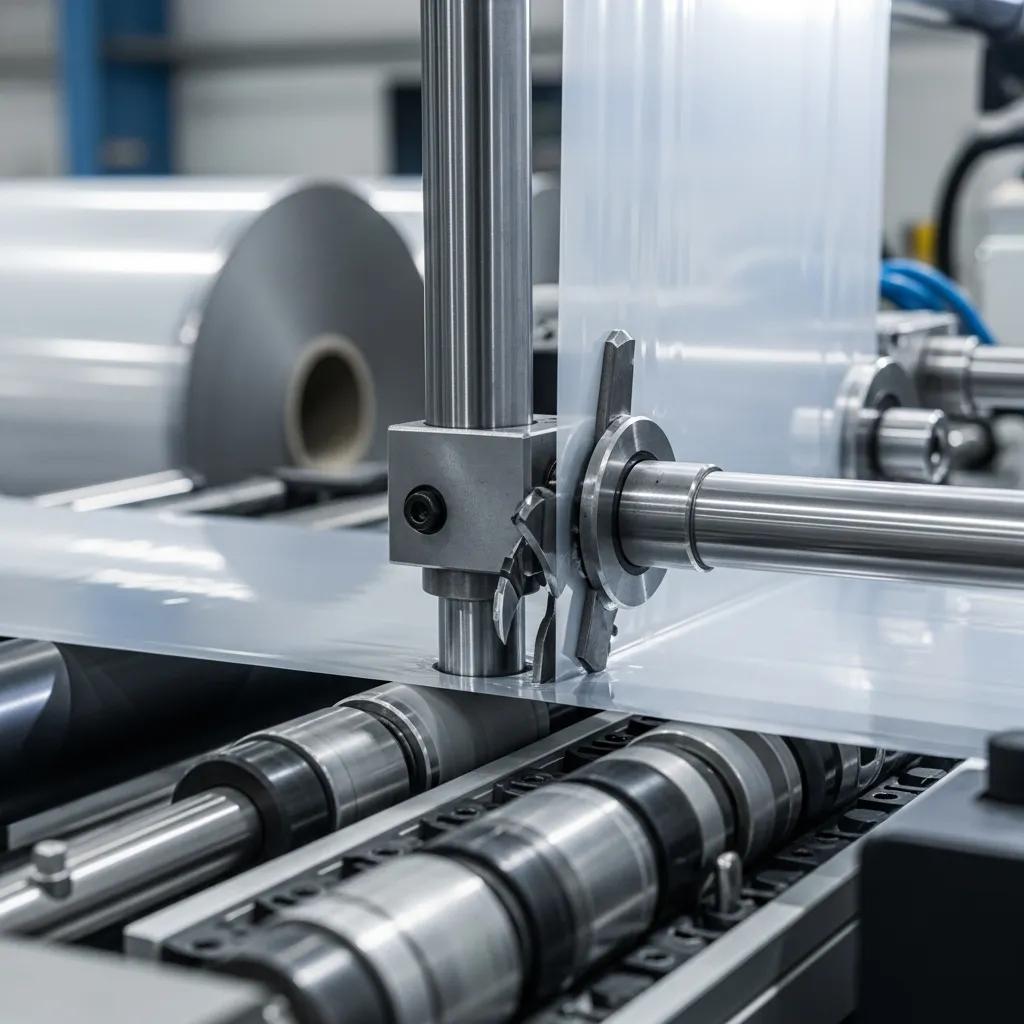
Tension control and knife selection are primary determinants of slit-edge quality and roll integrity. A closed-loop tension system senses web strain and adjusts braking or torque to maintain consistent tension; this prevents wrinkles, edge folding and telescoping that otherwise cause downstream rejects. Knife systems—shear blades for thicker films or razor knives for thin, brittle films—must be matched to material properties and production speed to balance cut quality against blade life. Regular calibration and knife maintenance are therefore essential preventive practices to ensure consistent slit quality and minimize unplanned stops.
Troubleshooting often focuses on tension setpoints, knife sharpness and web guiding alignment; addressing these root causes quickly restores production quality.
Automation features significantly raise effective throughput by reducing changeover time and operator dependence. Key enhancements include automatic knife positioning, stored recipe recall, servo-coordinated roll changes, remote diagnostics and automatic core loading or roll splicing. These functions cut manual setup time, lower skill dependency for repeat jobs and reduce human error that can cause material waste. For buyers, the ROI case for automation typically includes reduced labor hours, fewer rejects and faster job sequencing across multiple SKUs.
A buyer checklist for evaluating automation should include: recipe management, knife auto-positioning accuracy, remote service capability and proven uptime statistics from the supplier.
Film slitting machines serve a range of industries in Boksburg and Ekurhuleni, from plastic bag production to label converters and flexible packaging manufacturers. Each industry processes specific film types and requires machine choices that reflect product width variability, required edge quality and downstream equipment compatibility. Mapping industry needs to material types helps procurement teams self-identify the right slitting class and setup.
The table below maps common industry segments to typical materials and primary use cases.
Introductory note: this mapping helps readers quickly identify which slitting approaches align with their industry needs.
| Industry | Material | Use Case |
|---|---|---|
| Plastic Bag Production | PE (LDPE/HDPE) | Sacks, carrier bags, industrial film |
| Flexible Packaging | BOPP, PET, PE | Pouches, laminates, printed film |
| Label Manufacturing | BOPP, PET, PVC | Pressure-sensitive label stock |
| Recycling / Reprocessing | Mixed films | Rewinding for reprocessing or shredding |
This industry mapping highlights that material properties—such as stiffness and thickness—drive knife type and tension control requirements, which in turn determine machine choice.
Different industries favor specific slitting configurations. Bag manufacturers often require robust slitter rewinders that handle thicker PE and allow fast roll changes for multiple widths. Flexible packaging companies processing BOPP and PET typically invest in automatic slitters that deliver razor/sharp shear edges to support high-quality printing and lamination. Label converters need narrow-web precision and edge cleanliness, prompting choices that prioritize fine web guiding and low-tension handling. Practical machine selection therefore depends on expected width ranges, run lengths and downstream feed speeds.
Assessing sample runs on a prospective machine or requesting trial slits from the supplier helps validate performance before purchase commitments.
Material differences require distinct slitting approaches: PE (flexible and stretchable) tolerates sharper blades at moderate tension, while BOPP and PET (stiffer, thinner) often benefit from shear cut or precision razor setups to avoid delamination or edge fray. PVC and coated films may demand specific blade materials and lower speeds to prevent melting or edge distortion. Knife selection (hardened shear knives vs. disposable razors), blade angle and tension setpoints must be matched to film properties for optimal edge quality.
A short materials checklist for slitting approach:
Plastic Bag Machine South Africa operates as a South African-facing platform for Kingdom Machinery Co., Ltd., offering slitting machines and complementary converting equipment to local manufacturers. The supplier emphasizes practical buyer needs such as simple operation, reliable performance and accessible maintenance to reduce operational risk. Plastic Bag Machine South Africa positions itself to support converters in Boksburg with machine supply options, technical specification advice and coordination for delivery and installation planning that aligns with local production constraints.
This supplier approach helps bridge specification questions—knife types, tension systems and integration needs—while leaving final technical decisions to the buyer’s engineering team and production objectives. For buyers prioritizing predictable commissioning and timely after-sales service, supplier responsiveness and spare-parts availability are decisive selection factors.
The supplier’s explicit value propositions include straightforward operation, dependable performance, manageable maintenance and timely after-sales service—attributes that reduce buyer risk during acquisition and commissioning. Other stated strengths are competitive pricing, 100 percent final inspection, strong research and development capabilities, one-stop customization services, robust production capacity and fast delivery. These UVPs map directly to buyer concerns about uptime, spare parts, customization to specific line layouts and delivery schedules.
Buyers should ask suppliers for documentation on final inspection procedures and clarify spare parts lead times to verify these claims during procurement discussions.
Specific case data was not provided here, so prospective buyers evaluating supplier impact should request quantified case metrics such as before/after scrap rates, changeover time reductions and uptime improvements. A useful case-study template for suppliers to supply during evaluation includes: baseline scrap percentage, throughput before/after installation, downtime reduction in hours per month and any measured improvements in downstream yield. Requesting these metrics helps procurement teams compare supplier claims to measurable outcomes relevant to Boksburg operations.
This illustrative approach ensures buyers can assess local impact and compare potential suppliers on consistent performance criteria rather than anecdotal claims.
Request a Quote/Contact Us: For inquiries and quotes, procurement teams can request machine specifications and proposals covering Slitting Machine, Blown Film Extrusion Machine, Plastic Bag Making Machine, Flexo Printing Machine and Plastic Recycling Machine offerings. Please provide your production targets, typical film types and desired throughput so the supplier can propose configurations and integration options tailored to your Boksburg facility.
Plastic Bag Making M
Plastic Recycling So
Plastic Recycling So
Plastic Recycling So