
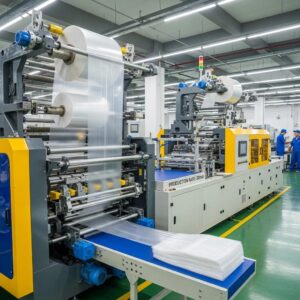
Plastic Bag Making Machines for Sale in Pretoria
Plastic Bag Making M
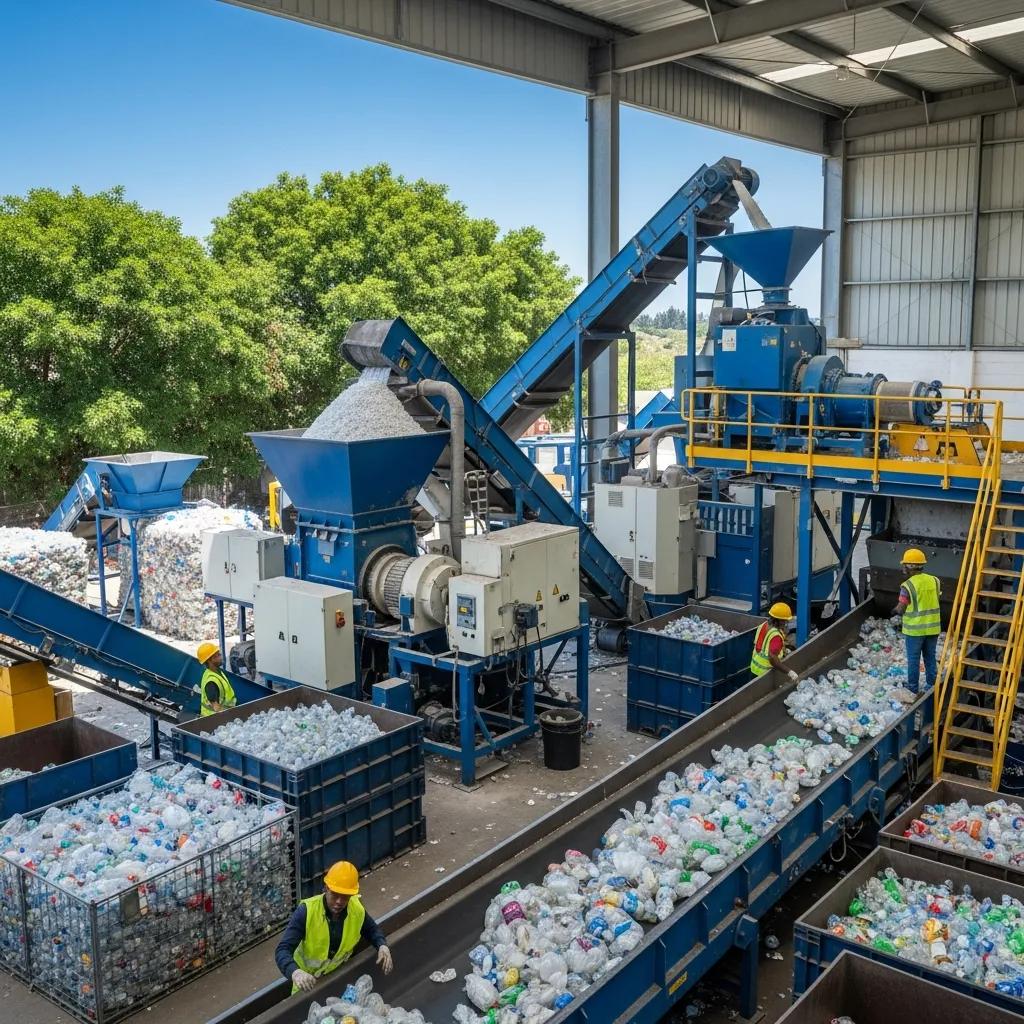
Port Elizabeth (Gqeberha) faces growing challenges from commercial plastic waste streams, and businesses need practical, on-site solutions that convert waste into usable feedstock. This article explains how commercial plastic recycling machines and integrated process lines turn film, bottles, and post-industrial scrap into pellets and reprocessable material, reducing disposal costs and supporting circular production. Readers will learn which machine classes suit regional needs, how to design a reprocessing flow from collection to pelletizing, the economic and environmental benefits, and material-specific processing guidance for LDPE, HDPE, PET and PP. The guide maps machine options, process steps, expected outputs, and local support pathways relevant to manufacturers, converters, and waste aggregators in the Eastern Cape. Throughout, we reference industrial examples and equipment classes such as pelletizers, granulators, shredders, washing lines and water-cooling recycling machines while pointing to supplier capabilities available in South African markets.
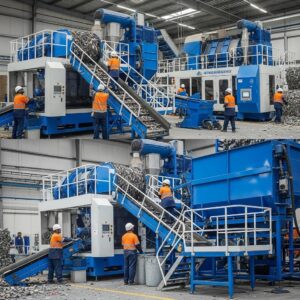
Plastic recycling machines are industrial systems that convert sorted plastic feedstock into cleaned flakes, granules, or pellets by combining size-reduction, washing, extrusion, and pelletizing mechanisms to yield reprocessable material. These systems work by removing contaminants, controlling melt characteristics through extrusion and pelletizer design, and stabilizing output with cooling assemblies like water-ring cooling or strand cooling; the result is regrind or pellets suitable for blown film, extrusion, or injection applications. Knowing machine classes and their typical throughputs helps businesses match capacity to waste volume and product goals, while choosing robust granulators and pelletizers improves downstream consistency. Below is a concise inventory of common machine classes and their high-level use-cases for Port Elizabeth operations.
The following list summarizes typical machine types and primary uses for quick comparison:
These machine classes form the backbone of most commercial recycling plants and lead naturally to choices between strand or water-ring pelletizing and appropriate granulator blade geometries, which we explore next.
Introductory comparison of machine capabilities follows to help buyers evaluate capacity and use-case alignment.
| Machine Class | Typical Capacity Range | Ideal Use-Case |
|---|---|---|
| Pelletizer (strand/water-ring) | 100–1,000+ kg/hr | Converting melt to pellets for film extrusion or injection blending |
| Granulator | 50–800 kg/hr | Producing uniform flakes from film, sheets or rigid scrap prior to washing |
| Shredder | 100–2,000 kg/hr | Coarse reduction of bulky waste like drums, crates or thick film rolls |
| Washing Line | 50–1,000+ kg/hr | Removing contaminants and preparing clean flakes for extrusion/pelletizing |
This table highlights typical throughput ranges and ideal applications so managers can match machine classes to expected waste volumes. The next subsections explain pelletizer and granulator selection in greater detail.
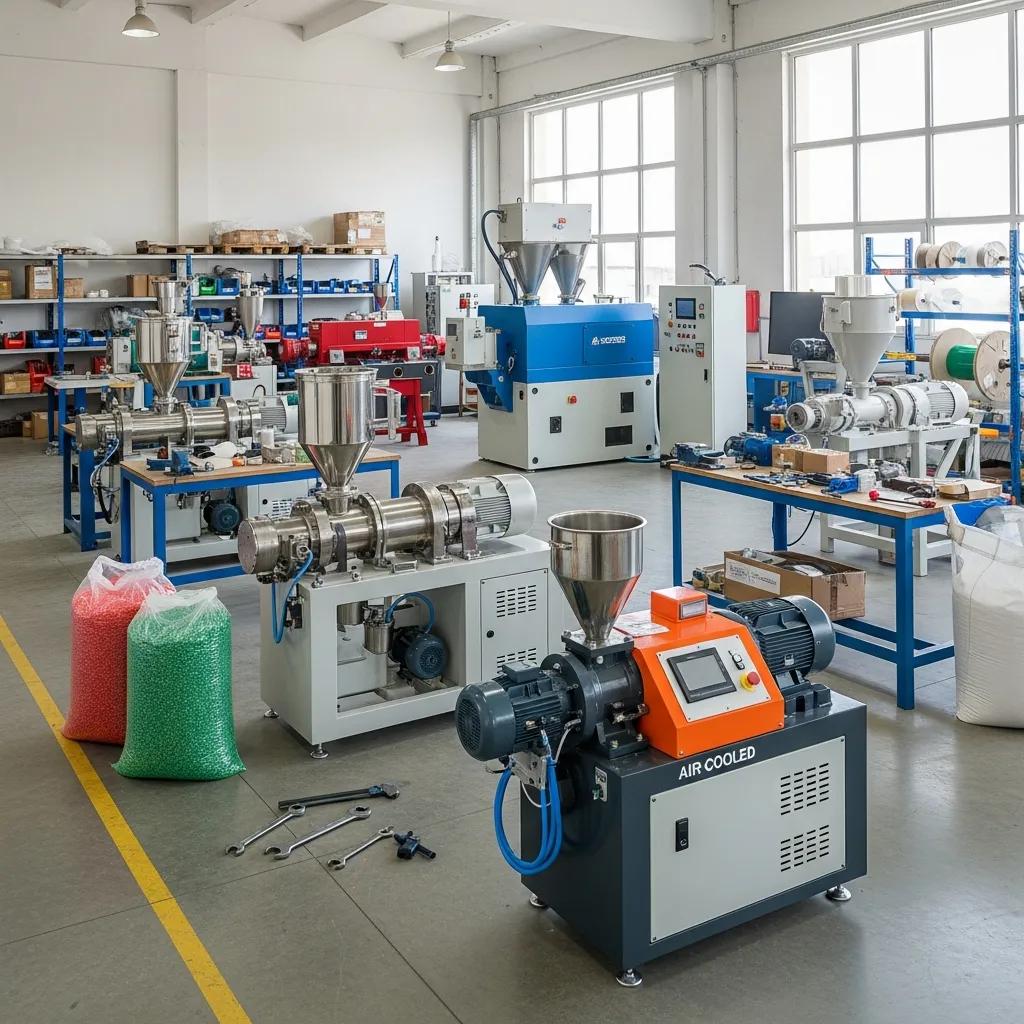
Industrial pelletizers convert molten polymer or flake via a die and cutting system into pellets that match required melt-flow and end-use specifications. Selection hinges on feedstock type (film, flake, regrind), desired pellet geometry, throughput targets, and cooling method—strand pelletizers work well for high-throughput engineering polymers while water-ring pelletizers excel when tight size control and immediate cooling are required. For South African processors handling film and LDPE/HDPE blends, mid-range pelletizers offering 200–600 kg/hr provide an efficient balance of energy use and output. Considerations include extruder screw design, die-face cutting versus underwater cutting, maintenance access to pelletizer head and the compatibility of the cooling water system with local utilities. Choosing the right model reduces downstream sorting and blending challenges and improves compatibility with blown film extrusion operations, which we address in the implementation section.
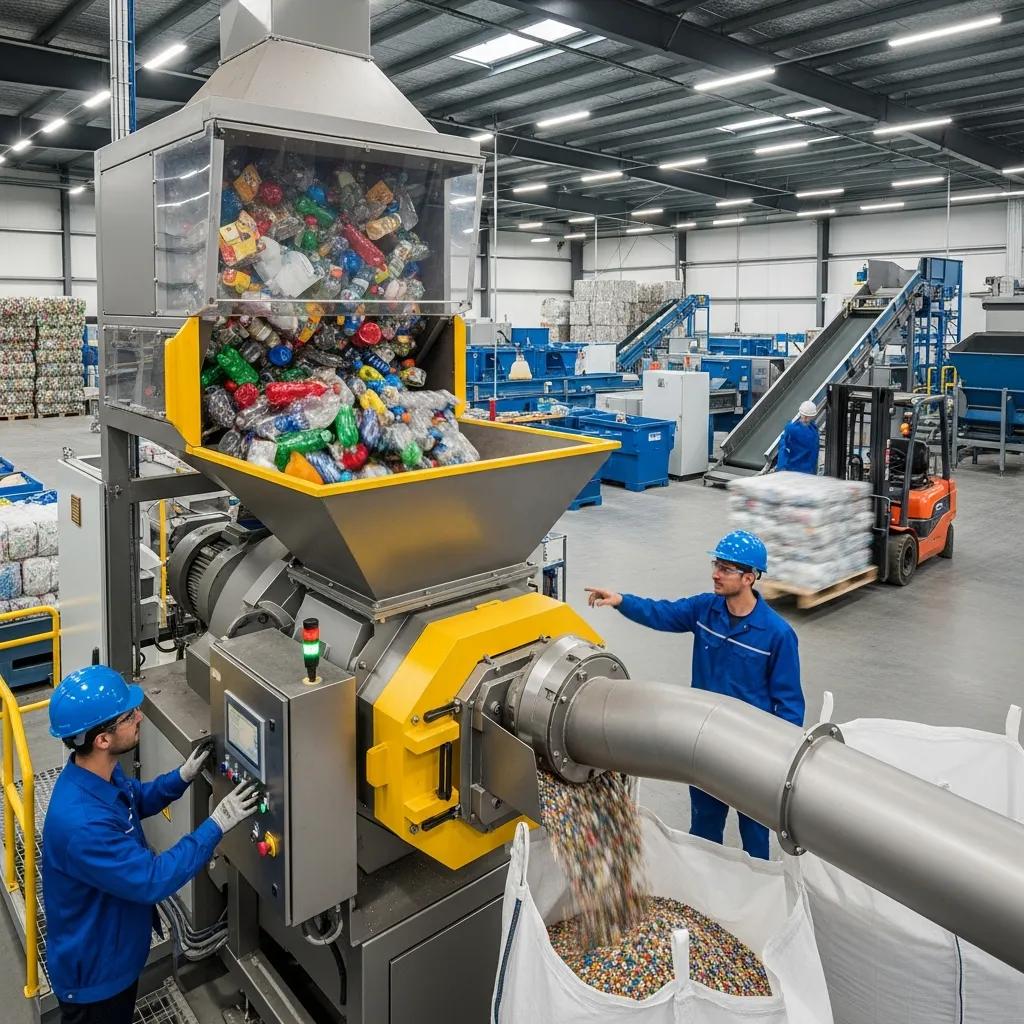
Granulators perform critical pre-pelletizing work by reducing variable scrap into consistent flake sizes, which improves washing efficiency and stabilizes feeding into extruders and pelletizers. High-torque, low-speed granulators reduce noise and dust while delivering uniform particle size; this uniformity enhances melt homogeneity and reduces back-pressure on extruders. Regular blade maintenance and accessible rotor design minimize downtime in continuous industrial lines, while rotor speed and screen sizing allow adaptation to LDPE film or thicker HDPE scrap. For Port Elizabeth facilities, granulators that handle film, sacks and trimmed blown film waste improve line uptime and reduce manual labor during sorting and feeding, creating a cleaner, more predictable input for pelletizing.
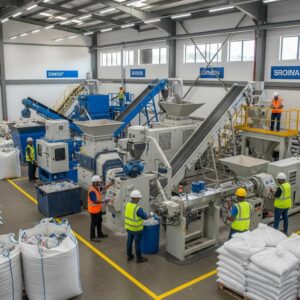
Implementing a commercial reprocessing solution requires planning across collection, pre-processing, washing, size reduction, extrusion and pelletizing to achieve consistent material quality and compliance with customer specifications. A successful installation balances throughput with space, utilities, and anticipated contamination levels, while designing hoppers, conveyors and sorting stations to minimize manual handling. Turnkey configurations often pair a washing line with granulator and pelletizer modules, permitting staged investment and scalability; integrating blown film extrusion downstream enables closed-loop reuse of post-industrial film scrap. Below we present a stepwise roadmap that businesses can adapt to local constraints and product goals.
The following numbered process provides a practical, featured-snippet-ready roadmap for implementing a recycling flow:
This sequence clarifies where machine choices affect downstream quality; the following subsection describes practical steps in more detail and common pitfalls to avoid when commissioning systems.
Commercial recycling workflows begin with collection and segregation, then move through washing, drying, size reduction, extrusion, pelletizing and quality control to produce saleable pellets or in-plant feedstock. Collection standards should separate films, rigid containers and PET bottles at source to reduce cross-contamination that complicates washing and extrusion. Washing systems use sequential tanks—flotation, friction, caustic if required, and rinsing—followed by centrifugal drying to hit moisture targets prior to extrusion; inadequate drying raises melt defects. During extrusion, degassing and melt-filtration remove volatiles and particulates, while pelletizer selection controls pellet shape and cooling; consistent QC on MFI/MFR, ash content and contamination percentage ensures acceptance by converters. Planning for maintenance, spare blades and routine screening reduces unplanned downtime and preserves pellet quality for reuse in blown film extrusion or other processes.
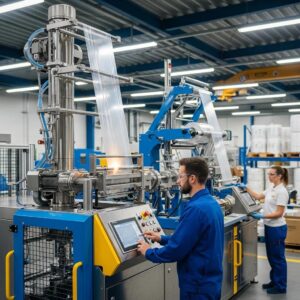
Combining recycling lines with blown film extrusion creates closed-loop opportunities that lower raw-material spend and improve material security for manufacturers producing film-based products. Recycled pellets with controlled melt-flow index can replace a share of virgin resin in formulations for agricultural film, packaging film and sacks, reducing procurement volatility while enabling cost savings. Technical considerations include monitoring melt index, limiting contamination levels to maintain optical and mechanical properties, and using appropriate additives or compatibilizers when blending polymers. Post-industrial film scrap that is clean and well-sorted yields the highest replacement ratios and easiest integration into blown film lines. Manufacturers who incorporate on-site pelletizing and immediate re-extrusion reduce transport costs and carbon footprint while stabilizing supply for continuous film production.
Commercial recycling delivers tangible economic benefits—reduced virgin resin purchases, lower disposal fees and potential revenue from selling pellets—while contributing to local environmental goals by diverting waste from landfill and lowering embodied carbon through material reuse. Savings depend on volume and blend ratios, but typical payback timelines for modular recycling lines are shortened when high-value post-industrial scrap is recovered and reused directly in production. Environmentally, recycling reduces transport and landfill emissions and supports circular-economy claims that can improve procurement outcomes and customer perception. Below we quantify common benefit categories and outline what drives return on investment for regional businesses.
Key financial and sustainability advantages include the following:
Understanding these drivers helps prioritize feedstock management and process controls that maximize ROI while delivering measurable environmental benefits; specific payback scenarios are discussed in the next subsection.
ROI for recycling equipment depends on feedstock volume, contamination rates, energy costs and intended use of recycled pellets; higher-quality, low-contamination input yields faster payback through greater replacement of virgin resin. Example scenarios show that processors who reuse post-industrial film on-site can often replace 20–50% of virgin resin usage in certain film grades, shortening payback periods compared to facilities relying solely on off-site pellet sales. Major cost factors include capital cost of pelletizers and washing lines, operating energy and labor, and maintenance; optimizing throughput and reducing manual sorting labor increases net savings. Sensitivity to contamination is high—improved upstream segregation and simple pre-washing can significantly enhance pellet value and minimize extrusion downtime, further improving ROI.
Plastic recycling machines enable measurable sustainability outcomes by diverting plastic from landfill, lowering embodied carbon in products, and supporting Extended Producer Responsibility (EPR) compliance through documented reuse streams and traceable material flows. Machines that produce standardized pellets allow manufacturers to report recycled content percentages and demonstrate circular procurement practices to customers and regulators. In addition to carbon savings, recycling reduces reliance on virgin resin supply chains and stabilizes material availability for local manufacturers. These environmental benefits are directly linked to machine selection, process control and quality assurance, making equipment choice a strategic sustainability decision for Port Elizabeth businesses.
Different polymer classes require tailored pre-processing and machine setups to achieve consistent pellet quality; LDPE and HDPE films, PET bottles, and PP have distinct washing, drying and extrusion behaviors that influence equipment selection and expected outcomes. Matching the polymer to the right granulator, washing regime and pelletizer avoids melt instability and contamination-related defects. Below is a material-specific mapping that highlights typical pre-treatment and recommended equipment for common commercial streams processed in the Eastern Cape, oriented toward producing reprocessable pellets for blown film, extrusion or injection molding.
The following list maps common polymers to primary end-uses and processing focus:
This mapping sets expectations for processing complexity and pellet quality; the table below provides recommended machine-process pairings and expected pellet quality outcomes.
| Plastic Type | Pre-processing Required | Recommended Machine/Process + Expected Pellet Quality |
|---|---|---|
| LDPE film | Sorting, flotation washing, gentle drying | Granulator → Water-ring pelletizer; pellets suitable for blown film with moderate clarity |
| HDPE (rigid/sacks) | Shredding, caustic washing for grease removal | Shredder → Heavy-duty granulator → Strand pelletizer; pellets for extrusion and molding |
| PET bottles | Bottle-to-flake washing, de-labeling, drying | Washing line → Flake dryer → Extrusion with decontamination; high-quality flakes for re-pelletizing |
| PP | Label removal, hot washing | Granulator → Pelletizer with filter; pellets suitable for injection or blended extrusion |
This table clarifies the link between polymer type, necessary pre-treatment and realistic pellet outcomes so buyers can match equipment and quality goals. Next, we describe polymer-specific processing details and typical applications for the recycled pellets.
LDPE films are delicate and benefit from low-torque granulation and gentle washing that preserve polymer chain length and film clarity; water-ring pelletizing helps stabilize pellet size and cooling for film-grade reuse. HDPE requires more aggressive shredding and high-temperature extrusion control to manage crystalline structure and remove residues, making it suited for pipe, sheet or sack production after pelletizing. PET bottle recycling typically involves flake production, hot-wash stages to remove adhesives and labels, and vacuum degassing during extrusion to reduce acetaldehyde and volatiles; re-pelletized PET often requires crystallization prior to drying for consistent melt-flow. PP processing follows similar washing and granulation steps but often needs targeted removal of inks and labels to avoid discoloration; compatibilizers can assist blending for mixed-waste feeds.
Recycled pellets serve a range of manufacturing applications depending on polymer type and quality, including blown film, injection molding, extrusion of profiles and non-food packaging. Blending ratios vary—film manufacturers often accept 10–30% recycled LDPE in commodity film, while non-critical injection parts can use higher percentages of recycled HDPE or PP. Quality benchmarks include melt-flow index (MFI/MFR), contaminant percentage, and color uniformity; meeting these ensures commercial acceptance by converters. Testing for ash content and mechanical properties before dispatch or reuse reduces rejection risk and clarifies appropriate replacement ratios for production runs.
Plastic Bag Machine South Africa (operating as Kingdom Machinery Co., Ltd.) supplies a range of plastic production and recycling equipment across South African cities including Gqeberha (Port Elizabeth), Soweto, Cape Town and Johannesburg, and offers support designed to enable turnkey recycling implementations and ongoing operations. Their product menu includes pelletizing equipment, granulators, shredders, washing lines and water cooling plastic recycling machines suitable for commercial recycling plants. The company emphasizes simple operation, reliable performance, easy maintenance and timely after-sales service to help local businesses commission systems and maintain throughput. Below we outline service components and timeline expectations that can guide procurement and project planning.
The next list highlights common buyer-focused services and what they typically cover when procuring commercial recycling equipment:
These offerings support businesses from initial installation through long-term operation, and the table below presents a scannable view of service scopes and typical timelines to set expectations before purchase.
| Service | Scope | Typical Timeline / Deliverable |
|---|---|---|
| Installation & Commissioning | Site assessment, equipment installation, trial runs | 1–4 weeks depending on system size; performance report delivered |
| Training & Handover | Operator and maintenance training modules, manuals | 2–5 days of on-site training plus documentation |
| Maintenance & Spare Parts | Routine maintenance plan, replacement parts availability | Scheduled maintenance cadence; spare parts shipped as per agreement |
| Financing Support | Guidance on financing structures and buyer preparation | Financing options discussed during quotation phase; timelines vary |
This table shows the service options and deliverables businesses should expect when engaging a supplier for recycling equipment. The following subsections expand on installation and financing details.
Installation typically begins with a site survey to determine foundations, power, water and layout requirements followed by staged equipment delivery, mechanical assembly and system integration testing. Local technicians or company field engineers perform commissioning runs while training operators on feed rates, blade maintenance and troubleshooting to ensure stable pellet quality. After-sales support often includes scheduled check-ins, spare-part lists for critical wear items like granulator blades and pelletizer cutters, and remote technical assistance to reduce downtime. Clear documentation, routine preventive maintenance schedules and a defined spare-parts inventory help local teams maintain consistent throughput and pellet standards over time.
Financing options commonly include capital leases, equipment loans and staged payment plans aligned with delivery and commissioning milestones to reduce upfront capital barriers and accelerate ROI. Lenders and lessors generally evaluate projected savings from reduced virgin resin purchases and disposal costs when assessing creditworthiness, so providing throughput estimates and cost-savings projections aids approvals. Structuring payments to match commissioning and production ramp-up can improve cash flow while enabling businesses to start realizing savings immediately. Preparing documentation—basic financials, project plans and expected payback analyses—streamlines discussions and helps vendors present practical financing pathways to buyers.
These steps help businesses secure practical financing and move from feasibility to operational savings without overstretching capital resources.
Plastic Bag Making M
Plastic Recycling So
Plastic Recycling So
Blown Film Extrusion