
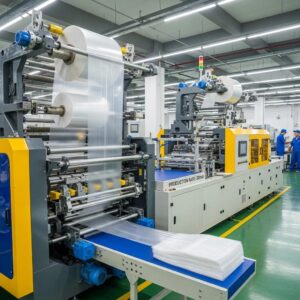
Plastic Bag Making Machines for Sale in Pretoria
Plastic Bag Making M

Advanced plastic washing lines are engineered process systems that convert contaminated post-consumer and industrial plastic waste into clean flakes suitable for mechanical recycling and downstream pelletizing. These systems combine sorting, pre-wash, mechanical size-reduction, friction washing, multi-stage rinsing, dewatering, and drying to remove soils, organics, adhesives, and labels, producing reusable plastic flakes that restore material value. South African processors benefit from reduced disposal costs, improved feedstock quality for local manufacturers, and stronger compliance with Extended Producer Responsibility (EPR) requirements when they deploy purpose-built washing lines. This article explains what advanced plastic washing lines are, the key components and stages of a washing plant, polymer-specific treatment strategies for PE/PP/PET/HDPE/LDPE, commercial and regulatory benefits for South African operations, supplier selection criteria, and practical application scenarios. Throughout, the piece highlights how modular plastic recycling machines and integrated washing-and-pelletizing configurations are sized and specified for contaminated streams to support circular-economy outcomes.
An advanced plastic washing line is a modular processing train that removes contaminants from mixed plastic waste using mechanical, thermal, and chemical-assisted washing steps to produce flakes with consistent purity and moisture suitable for reprocessing. These systems work by combining sequential operations—pre-sorting, coarse washing, shredding, friction washing, hot or cold tanks, rinsing, dewatering, and drying—so that each stage reduces a specific contamination class and improves overall flake quality. The primary benefit is to reclaim value from contaminated streams such as soiled film and mixed rigid plastics, enabling higher resale prices and local reprocessing into new products. Understanding component roles and process controls is essential for designing lines that meet throughput, purity, and energy targets in South African recycling operations.
Plastic washing lines support recovery by converting low-value, contaminated inputs into stable intermediate flakes that feed pelletizers or direct remanufacturing processes. These systems therefore bridge the gap between waste collection infrastructure and local manufacturing demand, increasing the supply of recycled PE, PP, and PET that South African industry can use. Properly configured washing lines also reduce landfill-bound waste and provide documented mass balances useful for EPR reporting. The next section explains how these washing lines specifically support circular-economy goals in South Africa.

Advanced washing lines increase material recovery rates by improving the quality and consistency of recycled plastic flakes, which makes local reprocessing economically viable and reduces dependence on virgin polymers. By converting contaminated agricultural film, post-consumer retail film, and mixed rigid scrap into saleable flakes, washing systems enable closed-loop or open-loop recycling options that feed local blown film extrusion and bag-making processes. This material recovery supports EPR objectives by demonstrating weight diverted from landfill and producing traceable recycled content for brand supply chains. Investment in washing infrastructure thus strengthens domestic circularity while creating value for collectors, processors, and manufacturers through higher recovered-material prices and reduced import reliance.
Stronger material streams also encourage local end-users to specify recycled content, increasing demand and creating a virtuous cycle. Improved flake quality reduces downstream processing issues such as pellet discoloration or inconsistent melt flow, which in turn lowers scrap rates in extrusion and printing operations. The role of washing lines in the circular economy therefore extends beyond waste cleaning to enabling repeatable, documented recycling loops that align with current policy and market trends.
Advanced washing lines are designed to process a variety of contaminated plastic streams including post-consumer film, agricultural film, industrial scrap, and dirty PET bottles, each with distinct contamination profiles and pre-treatment needs. Film streams often carry soil, organic residues, and heavy adhesives that respond well to friction washing and hot-water tanks, whereas rigid scrap and PET bottles typically require label removal, adhesive stripping, and float/sink separation. Industrial scrap may include mixed polymers and additives that necessitate robust sorting and density-based separation before washing to avoid quality issues. Understanding feedstock characteristics drives equipment selection and operating parameters for each line.
Processors commonly categorize incoming loads as light-film, heavy-film (agricultural), rigid HDPE/PP scrap, and PET bottle streams, and design pre-sorting flowsheets accordingly. Effective pre-treatment reduces downstream wear and minimizes the number of intense wash cycles required, while poor feedstock preparation increases operating costs and reduces achievable flake purity. The next major section details the components and stages that make these cleaning outcomes possible.

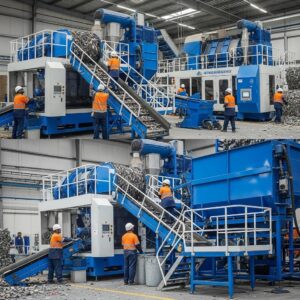
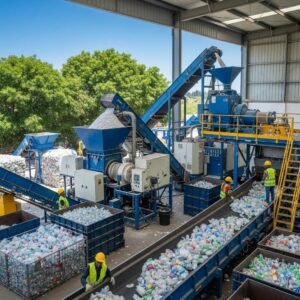
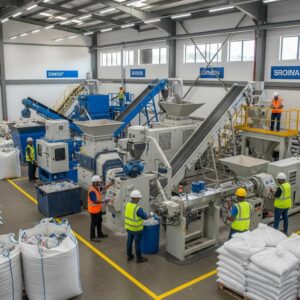
Advanced washing lines use a sequence of dedicated modules that together remove contaminants and produce stable flakes; each module has a clear functional role and throughput expectation. Typical stages include feed hopper and manual sorting, trommel or density separation, shredder/granulator, friction washer(s), hot wash tank, multi-stage rinsing, mechanical dewatering, thermal drying, and optional pelletizing. Process control variables such as wash temperature, retention time, rotational speed in friction washers, and dryer throughput determine both the final moisture and purity metrics. Designing a line requires balancing expected input contamination, target throughput (kg/hr), and allowable energy and water use to meet both commercial and environmental objectives.
An equipment-mapping approach helps processors evaluate modular configurations and scalability: smaller plants may combine a shredder, single friction washer, and a thermal dryer, while larger systems add multi-stage friction and counter-current rinsing plus integrated pelletizing. Understanding the role of each stage lets operators prioritize modules that yield the biggest purity gains for a given feedstock. The following table explains key components, their purpose, and typical impact on output purity and throughput.
| Component | Function | Typical Impact / Throughput |
|---|---|---|
| Pre-sorting / Trommel | Removes oversized contaminants and segregates film vs. rigid pieces | Reduces manual sorting time; protects downstream equipment |
| Shredder / Granulator | Reduces size, increases surface area for washing | Enables efficient friction action; typical output 200–1500 kg/hr per unit |
| Friction Washer | Mechanical abrasion to remove adhesives and labels | Major purity uptick; removes tacky residues and fine dirt |
| Hot Wash Tank | Thermal and surfactant-assisted cleaning | Dissolves oils and melts residues; improves float/sink separation |
| Dewatering Machine | Centrifugal or screw press to lower moisture | Reduces moisture to ~20–40% before dryer |
| Drying System | Thermal or hot-air drying to target moisture <2% for pelletizing | Prepares flakes for extrusion or pelletizing |
Pre-washing and sorting remove large contaminants, segregate polymer families, and reduce organic loading before mechanical size reduction, which protects grinders and increases washing efficiency. Manual picking lines, trommels, and density separators are commonly used to separate film from rigid pieces and to extract large stones, metals, and non-plastic items. A coarse pre-wash with water or a rotary washer loosens soil and organic films, lowering biological contamination and preventing fouling in subsequent stages. Proper pre-treatment also simplifies process control: a cleaner feed reduces required hot-wash cycles and chemical dosing while improving overall throughput.
Effective pre-sorting directly reduces operating downtime from jams or equipment wear, and it raises the baseline purity of flakes entering friction washers. Operators should implement inbound inspection and basic segregation rules to maintain consistent feed composition, because variability in incoming loads leads to frequent adjustments and inconsistent product quality. The next subsection explains shredding, friction washing, and drying mechanics that complete the cleaning train.
Shredding/granulation increases surface area and creates uniform particle sizes so friction washing and hot tanks can contact contaminants efficiently, while friction washers remove adhesives and labels through mechanical abrasion and surfactant action. Multi-stage rinsing sequences use counter-current water flows and flotation to separate fines and density-based contaminants, and dewatering equipment (centrifuge or screw press) reduces surface moisture prior to thermal drying. Dryers then lower moisture to the levels required for pelletizing; typical targets are under 2% moisture for PET and low-single-digits for PE/PP. Together, these stages transform heavy contamination loads into flakes that meet downstream specifications.
Maintaining the correct sequence and retention times maximizes contaminant removal while minimizing energy and water usage. For instance, insufficient rinsing leaves fines that darken pellets, whereas over-aggressive drying wastes energy and can thermally damage certain polymers. Balancing these trade-offs is central to designing an efficient washing line, and the next section covers polymer-specific processing strategies.
Industrial washing plants are routinely configured to process PE, PP, PET, HDPE, and LDPE streams, but each polymer class demands tailored washing tactics to address common contamination and achieve target flake quality. Films (LDPE/LLDPE/HDPE film) often require friction washing and hot-water washing to remove soil and adhesives, while PET bottles benefit from hot-wash tanks, label flotation, and adhesive removal steps plus floatation steps to separate caps and other polymers. Rigid HDPE and PP parts need more aggressive shredding and sometimes multi-stage friction washing to eliminate embedded residues. Recognizing polymer-specific behaviors and density differences guides the selection of float-sink media, wash temperatures, and mechanical settings.
A compact EAV-style comparison clarifies typical contamination types and recommended process responses for each polymer class, enabling practical equipment specification decisions for South African processors.
| Polymer | Typical Contamination | Recommended Process |
|---|---|---|
| PET | Labels, adhesives, food residues | Hot wash + friction + float-sink separation |
| PE (film) | Soil, organics, adhesives | Friction washing + cold/hot tanks + dewatering |
| PP (rigid/film) | Oil, pigments, fillers | Shredding + high-shear friction washing |
| HDPE | Grease, pigment inclusions | Intensive hot wash and multiple rinses |
| LDPE | Tacky adhesives, high dirt | Extended friction cycles + careful drying |
PE and LDPE films commonly enter a process that starts with coarse pre-wash, followed by shredding and friction washing in water with moderate surfactant, then multi-stage rinsing and dewatering before drying for flake sale or pelletizing. PP and HDPE rigid scrap often require heavier-duty granulation and higher mechanical agitation plus hot-water stages to remove oils and pigments. PET bottles typically undergo label separation, hot alkaline washing to remove adhesives, float-sink separation to exclude caps and contaminants, and rinse cycles designed to eliminate fines. Each polymer’s treatment checklist focuses on contamination type, target moisture, and permissible thermal exposure during drying and pelletizing.
Processors aiming for consistent flake quality should target specific output metrics—for example, PET flakes with low label residue and <2% moisture, or PE/PP flakes with minimal dirt and moisture below pelletizing thresholds. Achieving these targets often requires iterative tuning of retention time, surfactant concentration, and mechanical speeds.
Processing different plastic types introduces cross-contamination risk, density overlap between additives and polymers, and difficulties with multi-layer or blended films that do not separate cleanly by density or friction. Mixed polymer loads can cause final material quality issues and impair melt properties in extrusion, while organics and adhesives demand additional hot-wash cycles that increase water and energy use. Additives and pigments may also create color and odor challenges that reduce the market value of recycled flakes. Mitigation strategies include improved inbound sorting, selective acceptance policies, and adding dedicated separation modules such as density tanks or optical sorters where justified by feedstock variability.
Operators must weigh the economic trade-offs between intensive cleaning and feedstock selection: sometimes a stricter acceptance policy that limits contamination yields better long-term returns than trying to clean very low-value mixed loads. The next H2 covers the business benefits and KPIs that drive such investment decisions.
Investing in advanced washing systems raises the commercial value of recovered plastics, reduces disposal costs, and supports regulatory compliance, delivering measurable operational and financial returns when properly sized and operated. High-quality washing lines increase output purity, enable higher resale prices for flakes, and provide the documented recycling throughput and mass balance data required for EPR reporting. Operationally, automation reduces manual sorting time and improves safety, while modular designs permit capacity scaling as feedstock volumes grow. For many South African processors, the combination of improved material prices and lower landfill fees provides a clear ROI pathway within typical investment horizons.
Below is an EAV-style table that links investments to key ROI drivers and measurable KPIs to help quantify expected benefits and support buy-versus-outsource decisions.
| Investment Area | KPI / Attribute | Expected Outcome |
|---|---|---|
| Washing system | Output purity (%) | Higher purity increases flake price |
| Automation | Labor hours saved | Lower operating cost and better throughput |
| Water recovery | Water use (m³/ton) | Reduced utility cost and environmental footprint |
| Energy efficiency | kWh/ton processed | Lower energy bills and operating margin improvement |
| Traceability systems | Recycled tonnes documented | Supports EPR compliance and reporting |
Washing lines streamline manual tasks through mechanized sorting, automated conveyors, and continuous washing modules, raising throughput while reducing handling-related contamination and damage. By applying targeted cleaning stages—friction washing for tacky adhesives, hot washing for oils, multi-stage rinsing for fines—the line incrementally improves flake purity to levels demanded by specific end-users. Efficiency gains include reduced downtime from jams, lower scrap rates in downstream extrusion, and improved water and energy balances through counter-current rinsing and water-reuse strategies. These operational improvements translate directly into higher resale values and lower per-ton processing costs.
Consistent product quality also shortens contract negotiation cycles with buyers and increases options for local reprocessors, enabling tighter integration with local manufacturing chains. The next subsection covers regulatory compliance benefits, particularly relating to South Africa’s EPR context.
Advanced washing lines help companies meet Extended Producer Responsibility obligations by increasing recovered tonnage, documenting material flows, and producing higher-grade recyclates that can be tracked back into supply chains. Facilities with robust measurement and reporting capabilities can provide verifiable recycled-content supply to producers and demonstrate diverted waste volumes for EPR reporting. Furthermore, consistent processing reduces the risk of rejected loads and improves the reliability of recycling claims. Investing in washing and traceability therefore supports both regulatory compliance and corporate sustainability commitments.
Accurate documentation of input and output streams, combined with measurable KPI improvements, provides the auditable records necessary for EPR submissions and for brand-level recycled-content verification. This administrative benefit complements the direct commercial returns of improved material quality.
Plastic Bag Machine South Africa, operating as Kingdom Machinery Co., Ltd., supplies a range of equipment relevant to contaminated-waste recycling, including plastic recycling machines and modular washing-line components that can be configured to match feedstock and throughput needs. Their product offering and service model emphasize simple operation, easy maintenance, timely after-sales service, and one-stop solutions that bundle production capacity with competitive pricing and fast delivery. For processors seeking supplier support in South Africa, these attributes reduce installation and commissioning risk while providing practical pathways to scale washing-and-pelletizing configurations that suit local markets.
For buyers evaluating vendors, the combination of modular plastic recycling machines and local support capacity helps shorten lead times and simplifies spare-parts sourcing. If you would like technical specifications or a formal quote for a configured plastic recycling machine or washing-line modules, please contact the supplier directly by email at sales@kingdommachine.com or by phone at +86 13088651008 to request a tailored solution.
Kingdom Machinery emphasizes several explicit UVPs that matter to South African recyclers: simple operation reduces training needs; perfect performance speaks to consistent output; easy maintenance lowers downtime; timely after-sales service improves uptime; quality assurance reduces warranty risk; strong R&D and production capacity enable customization; competitive prices and fast delivery support capital planning; and one-stop service simplifies procurement. Each UVP maps to an operational implication—lower TCO from easy maintenance, faster ramp-up from simple operation, and predictable supply chains from quality assurance and fast delivery.
These supplier qualities help processors adopt more advanced washing-line technologies more confidently, because predictable support and modular offerings reduce the barriers to scaling from pilot to commercial throughput.
Local support and timely after-sales service ensure rapid response for parts replacement, on-site commissioning, and operator training, all of which shorten downtime and improve the long-term economics of a washing line. Access to spare parts and trained technicians near Johannesburg, Cape Town, or other South African hubs reduces lead times compared to distant suppliers, while local training programs accelerate operator competence and safe operation. Warranty and service agreements further limit unexpected expenses and encourage continuous performance optimization through preventive maintenance programs. These services therefore reduce total cost of ownership and increase the predictable uptime of complex recycling machinery.
Practical after-sales support also enables operators to fine-tune washing parameters and integrate lines with downstream blown film extrusion or bag-making processes, maximizing the value recovered from contaminated waste.
In South African recycling projects, advanced washing lines are applied to convert agricultural film and mixed post-consumer film into saleable flake that feeds local blown film extrusion and bag-making operations, thereby creating closed-loop manufacturing opportunities. Project implementations typically start with pilot lines that validate feedstock quality and throughput, then scale to integrated washing-and-pelletizing systems as demand for recycled feedstock grows. Integration considerations include moisture targets, pellet-quality requirements, and logistics for handling wet and dry materials. Real-world deployments emphasize modularity, water recycling, and space-efficient layouts to fit within existing facilities.
Processors planning installations prioritize reliable KPI measurement and traceability to support EPR reporting and to demonstrate the business case to funders. The following anonymized case-style examples illustrate how issues are resolved in practice through appropriate module selection and process tuning.
Example projects typically follow a problem→solution→outcome framework: Problem: heavily contaminated agricultural film with soil and adhesives prevented local reprocessing; Solution: a line with trommel pre-wash, high-torque shredder, dual-stage friction washers, and counter-current rinsing plus centrifuge dewatering; Outcome: example metrics showed a realistic improvement to 85–92% usable flake with throughput of several hundred kg/hr and reduced disposal costs. Another anonymized framework: Problem: mixed PET bottle stream with label residue; Solution: hot-wash tank with alkaline detergent, label flotation, and thermal drying; Outcome: PET flakes with <2% moisture and acceptable clarity for pelletizing.
These anonymized examples highlight how correct module selection and process sequencing deliver measurable purity and throughput improvements without inventing specific customer names or results.
Integrated drying and pelletizing reduce material handling steps by taking wet flakes from the washing line through dewatering, drying, and extrusion-pelletizing in a contiguous flow, minimizing moisture reuptake and contamination risk. Typical considerations include achieving moisture targets (<2% for PET, low-single-digits for PE/PP) before extrusion, controlling melt temperatures to avoid degradation, and balancing energy use across drying and extrusion stages. Integrated lines also simplify logistical flows and reduce transfer-related contamination, improving final pellet consistency and color control for end-users.
These integration benefits make a compelling case for processors who want to close the loop from contaminated waste to finished recycled pellets suitable for local manufacturing.
Plastic Bag Making M
Plastic Recycling So
Plastic Recycling So
Plastic Recycling So