
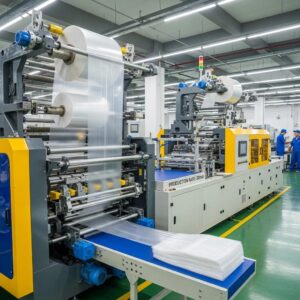
Plastic Bag Making Machines for Sale in Pretoria
Plastic Bag Making M
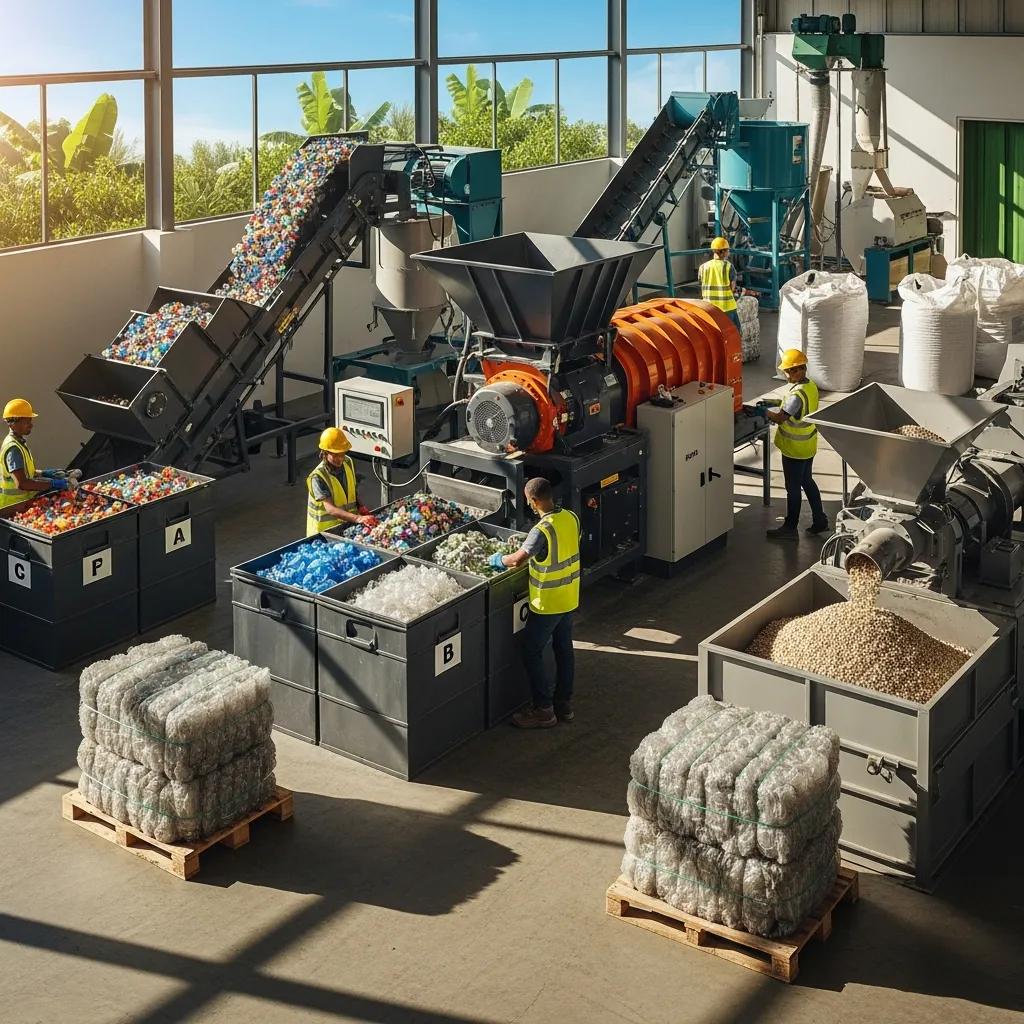
Plastic waste is an increasing operational and regulatory challenge for Bloemfontein businesses, and this guide explains how on-site recycling machines, pelletizing workflows and compliance strategies can turn that challenge into an operational advantage. You will learn which machine categories matter locally, how pelletizing and granulation processes work, what plastics can be handled by common equipment, and which services support installation and compliance in the Free State. This article defines machine types (pelletizers, extruders, shredders, washing lines, dryers, blown film and bag-making equipment), maps process steps to equipment, and outlines ROI drivers and practical KPIs. It also highlights local supplier capabilities and after-sales considerations relevant to Bloemfontein operations, with concrete comparisons and decision tables to guide purchasing. Read on for actionable next steps to match capacity, feedstock and budget to the right industrial recycling equipment while meeting Extended Producer Responsibility (EPR) expectations and reducing material costs.
Plastic recycling for businesses relies on several core machine categories that convert waste into reprocessable pellets or finished film and bag products. These machine categories—shredders/pulverizers, washing lines, extruders, pelletizers, dryers, blown film extrusion lines and bag-making lines—work together to remove contaminants, melt and reform plastics into pellets or finished goods. Understanding these categories helps manufacturers choose equipment matched to feedstock quality, throughput targets and intended end-use. The table below compares typical machine types, representative output ranges and common polymer targets to support buyer decisions and clarify which machines suit small workshops versus medium or large recycling operations.
This quick-reference table helps procurement teams compare capacity and suitability across common recycling machine types.
| Machine Type | Typical Output Range | Commonly Processed Polymers |
|---|---|---|
| Shredder / Pulverizer | 50–1,000 kg/hr | LDPE film, HDPE containers, PP parts |
| Washing Line (incl. tanks) | Batch to 1,500 kg/hr | PET bottles, PE films, mixed packaging |
| Extruder (single/twin-screw) | 50–1,200 kg/hr | LDPE, HDPE, PP, blended regrind |
| Pelletizer (strand/die-face/water-ring) | 50–800 kg/hr | HDPE, LDPE, PP, recycled blends |
| Blown Film Extrusion Line | 50–600 kg/hr (film) | LDPE, LLDPE for films and sacks |
| Bag-Making Machine | Depends on film width & speed | Finished LDPE/HDPE bags and sacks |
This comparison shows how machine selection aligns with polymer type and throughput; the next subsection explains pelletizers in more detail and how they support Free State manufacturers.
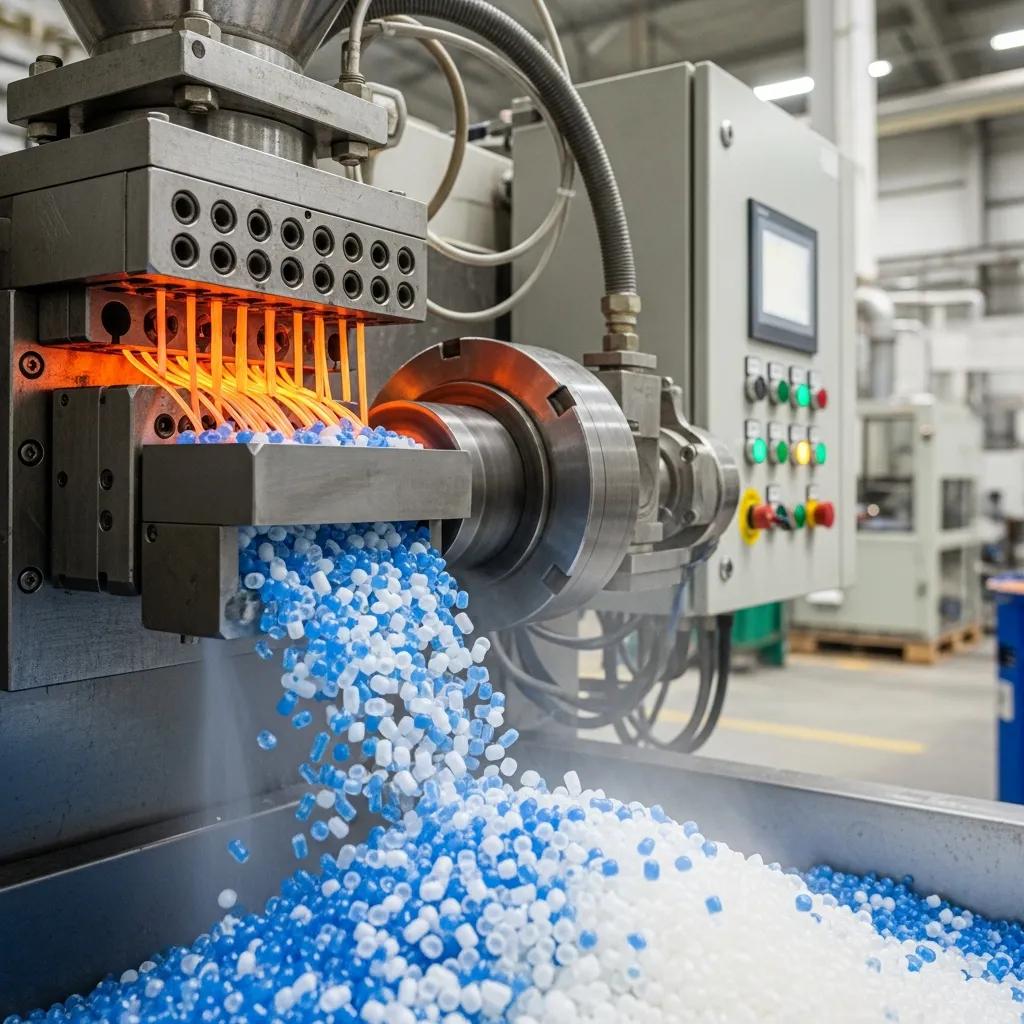
Plastic pelletizer machines convert molten polymer streams into consistent pellets that can be reintroduced into production or sold as secondary raw material. Pelletizers operate after extrusion: the polymer melt is cut into uniform granules using strand or die-face pelletizing systems, and cooling methods (water-ring or air) determine pellet surface quality and drying needs. For Bloemfontein manufacturers, pelletizers reduce raw-material purchases by reclaiming process scrap, lower disposal costs by diverting waste from landfill, and create a controlled feedstock for blown film or injection processes. Operational considerations include power supply stability, factory footprint, and the need for prewashing and dewatering—factors that influence whether a strand pelletizer or die-face system is more appropriate for a given throughput and polymer type.
These practical factors lead into the quality and feature expectations buyers should set for commercial recycling equipment in South Africa.
Buyers should expect industrial recycling equipment to prioritize simple operation, robust performance, and ease of maintenance to ensure long-term uptime and manageable operating costs. Features to seek include accessible maintenance points, modular spare-part layouts, automation for feed and temperature control, energy-efficient drives, and built-in safety interlocks that reduce operator intervention and risk. Quality assurance practices such as final inspections and warranty coverage help protect capital investments; reputable suppliers often provide performance testing and component warranties. Choosing equipment with efficient water and energy use, straightforward controls, and available spare parts reduces lifecycle costs and simplifies integration into existing production lines.
These equipment attributes segue into how to implement granulation processes on-site and what operational steps are required.
Implementing granulation begins with proper feedstock preparation—sorting by polymer, removing contaminants, and ensuring an appropriate moisture profile—then selecting granulator capacity and blade geometry to match material type. Granulation reduces bulky plastic items and films into uniform particles that downstream washing and extrusion systems can handle more efficiently, minimizing blockages and improving melt consistency. Operational best practices include controlled feed rates, scheduled blade maintenance, and contamination monitoring to prevent quality loss and equipment damage. Businesses should also plan material flows and storage to maintain a steady input stream and avoid mixed-polymer batches that reduce pellet value.
Below is a short list of core granulation implementation steps and common pitfalls to watch for when planning on-site granulation.
Well-managed granulation lowers the contamination rate and improves extrusion yields, which naturally leads to decisions about which granulator models suit different operations.
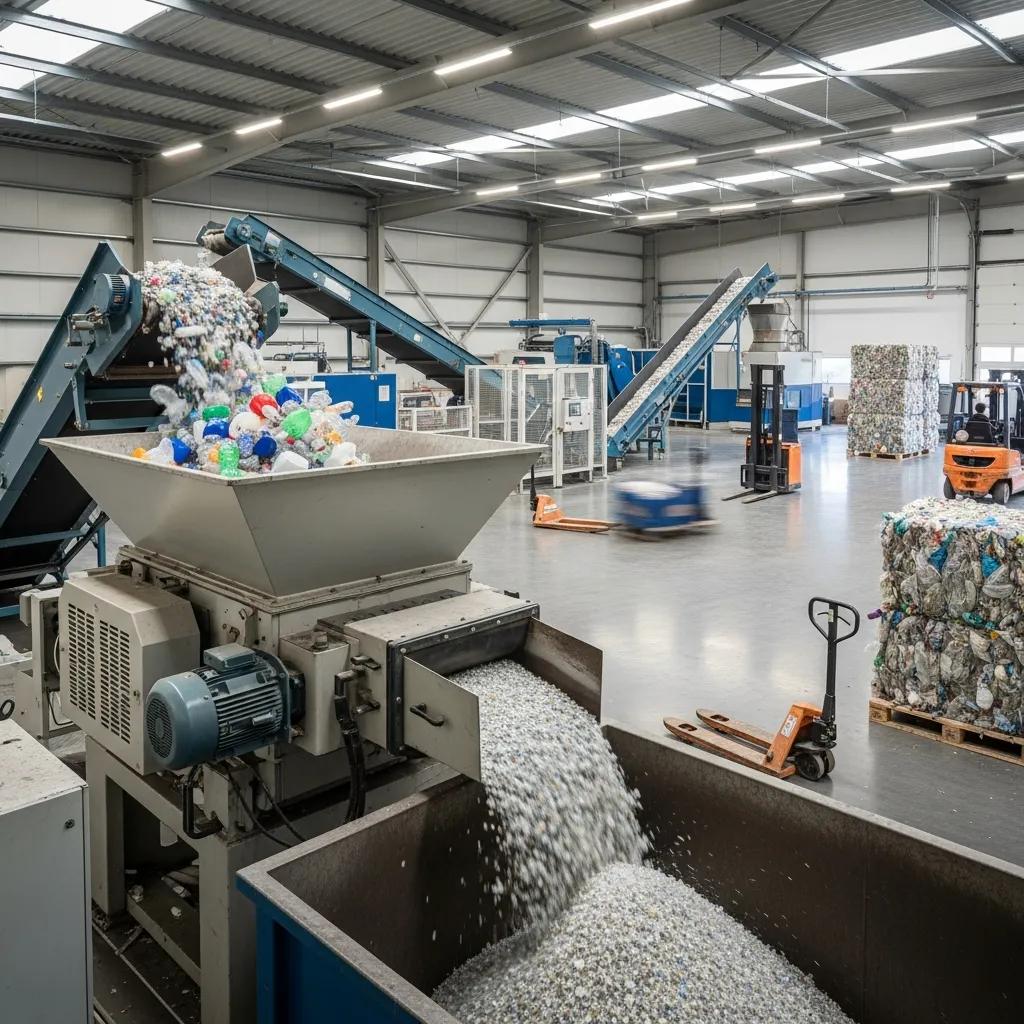
Waste plastic granulators mechanically reduce film rolls, rejected bags and rigid parts into consistent particles suitable for washing and extrusion. Granulators provide the particle-size control necessary for effective washing and improve throughput stability by delivering a steady feed to extruders and pelletizers. Blade design, rotor speed and screen selection determine particle size distribution and throughput; films generally require low-speed, high-torque granulators to avoid agglomeration while rigid materials handle higher-speed cutting. For Bloemfontein operations, granulators must balance footprint, noise control and dust management while delivering particle sizes that optimize washing efficiency and extrusion melt quality.
This understanding of granulator mechanics leads directly into a framework for selecting industrial equipment suited to different business scales and feedstocks.
Choosing the right equipment depends on the waste stream, target throughput and whether the goal is internal reuse or producing saleable pellets. Small workshops often pair a compact shredder, basic washing tank and a low-capacity single-screw extruder with a strand pelletizer; this setup minimizes capex and footprint while enabling internal reuse. Medium manufacturers benefit from twin-screw extruders for better melt homogenization, integrated washing lines and higher-capacity pelletizers to supply internal film or bag lines. Large recyclers require industrial shredders, multi-stage washing, twin-screw extrusion with devolatilization and high-capacity die-face pelletizers for commercial pellet sales. Assessing contamination levels, target pellet specification and available floor space helps map the optimal machine pairing for each scenario.
The next section explains why investing in recycling delivers environmental and economic value for Bloemfontein businesses.
Plastic recycling delivers environmental benefits—reduced landfill use, lower local pollution and resource conservation—and economic advantages such as reduced raw-material purchases and new revenue from recycled pellets. Recycling also aligns with evolving regulatory frameworks like Extended Producer Responsibility (EPR), which place obligations on packaging producers and can impose costs or reporting requirements on non-compliant businesses. By processing waste on-site or locally, companies reduce transport emissions, manage supply volatility of virgin resins, and demonstrate circular economy practices that strengthen brand reputation. These combined effects make recycling both a risk-management and opportunity strategy for manufacturers and converters in the Free State.
Understanding these benefits frames an evaluation of the specific environmental and economic outcomes businesses can expect from on-site recycling.
Recycling reduces landfill volume and associated fees, lowers the carbon footprint compared with virgin resin production, and conserves raw materials through closed-loop reuse. Economically, on-site pelletizing and reprocessing can lower resin procurement costs, reduce waste disposal charges, and create revenue streams by selling standardized pellets to local converters. Operational examples show that improved yield and contamination control translate directly into material cost offsets and lower downtime. Businesses that quantify these savings and track material diversion rates can demonstrate measurable return on investment and improved sustainability reporting for stakeholders.
These benefits connect directly to regulatory drivers such as EPR and how machinery investments can assist compliance.
Extended Producer Responsibility requires producers and importers of packaging to take accountability for end-of-life management, often through reporting, financial contributions or take-back obligations. For Bloemfontein businesses, EPR compliance options include partnering with accredited waste-service providers, participating in collective schemes, or implementing on-site recycling to reduce the net packaging impacts. On-site recycling and pelletizing reduce the volume of packaging entering the waste stream and can lower compliance fees and reporting burdens by demonstrating material recovery. Planning ahead to document material flows and recovery rates helps businesses meet EPR timelines and reduces the risk of penalties or reputational exposure.
Addressing EPR needs leads into a clear step-by-step description of how recycling processes operate from collection to pellets.
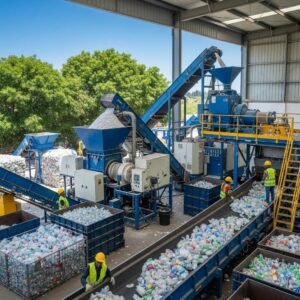
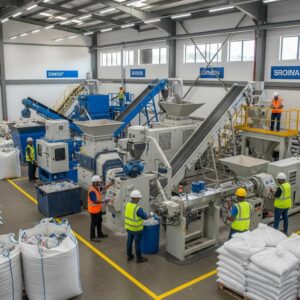
Recycling processes typically follow a defined flow: collection and sorting, shredding/granulation, washing and dewatering, extrusion and pelletizing, cooling and screening, and final quality control before reuse or sale. Each stage improves material cleanliness and homogeneity, with specific equipment handling particle-size reduction, contaminant removal and melt filtration to ensure pellet quality. Process control points include moisture content, melt-flow consistency and contamination thresholds; monitoring at these points prevents downstream defects and ensures predictable yield. The table below maps each process step to the primary equipment used and the expected outcome to clarify how investments translate into material quality improvements.
This process-to-equipment mapping helps operations teams plan line layouts and quality checkpoints.
| Process Step | Primary Equipment | Outcome / Benefit |
|---|---|---|
| Collection & Sorting | Manual sort stations, conveyors | Reduced contamination and clear feedstock streams |
| Shredding / Granulation | Shredder, granulator | Uniform particle size for washing and extrusion |
| Washing & Dewatering | Washing tanks, centrifuge | Removes labels, adhesives and fines; improves melt quality |
| Extrusion & Pelletizing | Single/twin-screw extruder, pelletizer | Homogenized melt and consistent pellet formation |
| Cooling & Screening | Water rings, vibrating screens | Stable pellet size and removal of oversized/fines |
| Quality Control | Melt filters, sampling equipment | Ensures pellets meet spec for reuse or sale |
With the process sequence established, a numbered breakdown of pelletizing steps gives a quick operational checklist for teams implementing these systems.
These operational steps set the stage for understanding which polymer types local machines can handle and their typical recycling routes.
Pelletizing begins with feedstock preparation—sorting and size reduction—followed by thorough washing and drying to remove contaminants that affect melt quality. Next, extrusion melts and homogenizes the polymer; melt filtration removes particulates before the material is cut into pellets by strand or die-face pelletizers. Cooling, dewatering and screening follow to ensure pellet consistency and remove fines that reduce product value. Final quality checks verify melt-flow index, moisture content and contamination levels to determine whether pellets are suitable for internal reuse or commercial sale.
This step-by-step sequence leads into a concise mapping of common polymers to their typical recycling approaches.
Common recyclable polymers in Bloemfontein equipment setups include HDPE, PET, LDPE/LLDPE and PP, each with distinct process routes: HDPE often goes through pelletizing for injection and blow molding reuse, PET requires targeted washing and sometimes hot-wash to remove labels before extrusion, LDPE film is cleaned and pelletized for film-to-film or bag applications, and PP can be reprocessed for non-food applications after melt filtration. Limitations include multi-layer films and heavily contaminated streams that reduce yield and pellet quality; these streams may need specialized separation or be diverted to lower-grade applications. Identifying polymer mixes in your waste stream is essential to specify the correct washing, extrusion and pelletizing configuration.
Having covered process mechanics and polymer routes, the next section outlines local support and services available to implement these solutions in Bloemfontein.
Bloemfontein businesses can access a range of local services including equipment suppliers, installation and commissioning teams, maintenance and spare-part providers, training for operators, and waste collection partners to stabilize feedstock supply. Suppliers and service partners typically offer after-sales support agreements, scheduled maintenance plans and operator training that help reduce downtime and improve yield. When engaging partners, ask for service-level agreements, spare-parts availability and training offerings to ensure long-term operational reliability. Local logistics and waste-management firms can also provide sorting and pre-processing services if on-site capacity is limited, enabling a hybrid approach that balances capital investment and operational flexibility.
Below is a short list of the practical services to evaluate when building a local support network.
Choosing the right mix of services helps businesses move from planning to steady-state operations efficiently.
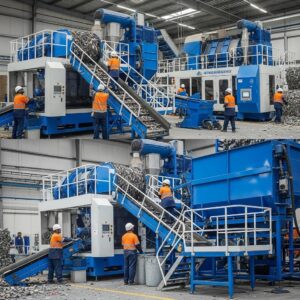
Plastic Bag Machine South Africa, operating as Kingdom Machinery Co., Ltd., supplies a range of production lines relevant to recycling and plastic processing, including plastic recycling machines, pelletizers, blown film extrusion lines, flexo printing equipment and bag-making machines. The company emphasizes simple operation, strong performance, easy maintenance and timely after-sales service, and it highlights quality assurance with 100 percent final inspection plus warranty coverage on certain components. For Bloemfontein buyers, these capabilities mean access to one-stop solutions for customized production lines and support for installation and ongoing operation, helping bridge the gap between equipment purchase and reliable output. Businesses should inquire directly about specific machine models, capacities and the supplier’s installation and training services to match offerings to their operational needs.
This supplier profile connects to where businesses can find additional compliance and advisory help locally.
Businesses seeking compliance assistance should consult national regulators, industry associations and local waste-service providers that offer EPR advisory, compliance audits and documentation support. Practical next steps include contacting industry bodies for scheme options, engaging compliance consultants for EPR reporting, and partnering with local recyclers or logistics firms to demonstrate material recovery. When evaluating partners, request references for EPR reporting, sample compliance documentation and examples of material recovery metrics to ensure they can support your obligations. Establishing these external relationships complements on-site recycling capabilities and simplifies meeting regulatory requirements while improving material diversion performance.
With services and suppliers in view, the final section shows how businesses can measure ROI and optimize investments to maximize the value of recycling solutions.
Maximizing ROI requires focusing on capex and opex drivers—machine selection, energy efficiency, yield optimization, contamination reduction and potential pellet sales—combined with measurable KPIs like yield percentage, downtime, energy per ton and contamination rate. Investment decisions should model payback periods based on avoided virgin resin purchases, reduced disposal fees and potential revenue from pellet sales. Operational optimization—improving sorting, washing efficiency and melt filtration—often yields faster payback than simply increasing capacity. The table below compares typical small, medium and large pelletizer scenarios to illustrate capex/opex considerations and expected payback ranges based on material savings and throughput.
This comparison clarifies how scale and process quality influence financial outcomes.
| Scale | Capex / Opex Considerations | Typical Payback Driver |
|---|---|---|
| Small pelletizer | Low capex, higher per-ton labor | Internal reuse; short payback via scrap reduction |
| Medium system | Moderate capex, better automation | Blend of internal use and pellet sales; mid payback |
| Large recycler | High capex, low unit opex | Commercial pellet sales; longer payback but higher margins |
Quantifying these elements informs procurement decisions and operational targets. The checklist below lists KPIs and practical steps operations should track to ensure ROI objectives are met.
These KPIs and controls lead to real-world implementations demonstrated in case summaries and operational comparisons.
Generalized case examples show that small manufacturers recovering in-house scrap with a compact shredder, washing station and low-capacity extruder can reduce virgin resin purchases by 15–30% and achieve payback in under 18 months. Medium-scale operations that improve sorting and install twin-screw extrusion with a quality pelletizer report higher-quality pellets suitable for local sale, reducing raw-material spend significantly and improving plant utilization. Key success factors across cases include rigorous contamination control, operator training, and close supplier support for spare parts and tuning. These lessons emphasize that process discipline and supplier service often determine whether the technical capability converts into sustained financial outcomes.
Understanding these outcomes clarifies why higher-spec equipment often yields better long-term benefits despite higher initial cost.
Investing in advanced machinery—automation, twin-screw extrusion, effective melt filtration and high-quality pelletizing—improves pellet consistency, reduces labour intensity and lowers contamination-related rejects. Advanced systems produce higher-spec pellets that command better resale value and support internal product quality, while automation reduces energy per ton and minimizes process variability. Over time, these improvements translate to higher throughput, lower OPEX per ton and a stronger business case for scale-up. Comparing conventional approaches to advanced systems shows that while capex rises, lifecycle savings and higher revenue potential from premium recycled pellets frequently accelerate net benefits and strengthen compliance readiness.
These operational benefits complete the guidance needed for Bloemfontein businesses to evaluate recycling investments and take practical next steps toward implementation.
Plastic Bag Making M
Plastic Recycling So
Plastic Recycling So
Plastic Recycling So