
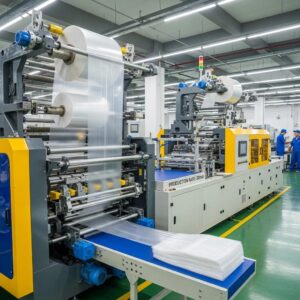
Plastic Bag Making Machines for Sale in Pretoria
Plastic Bag Making M
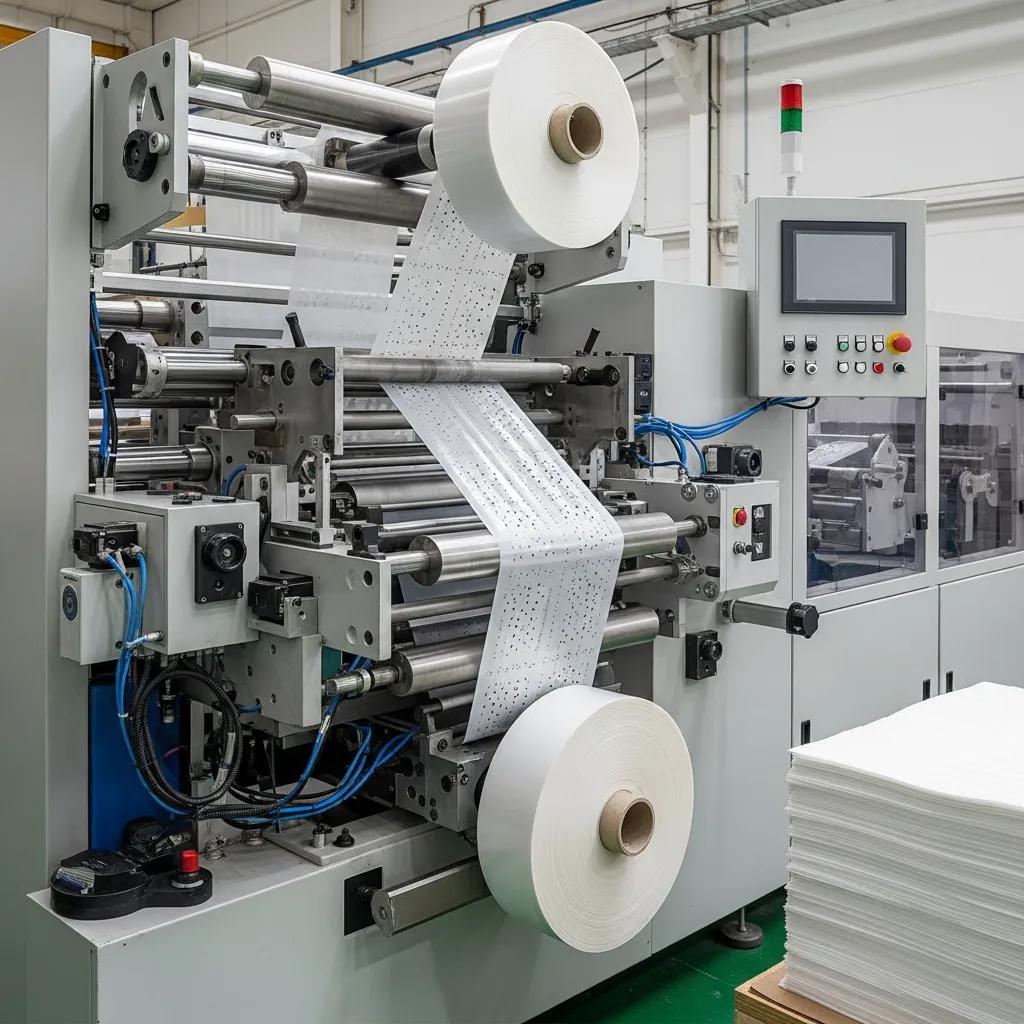
Roll bag making machines convert extruded plastic film into perforated bags on a roll, enabling efficient dispensing and packaging for refuse, produce, and retail applications. This article explains how these machines work, which features enable high-speed perforated bag production, compatible materials, and the operational benefits South African manufacturers gain when they adopt automated roll bag production. Readers will learn the core process steps—film feeding, sealing, cutting, perforation, and winding—plus how components such as servo motors, photocell sensors, perforation units, and winding systems affect throughput and quality. The guide also covers material selection (HDPE, LDPE, LLDPE, recycled and biodegradable films), integration with blown film extrusion or flexo printing, and practical procurement considerations including after-sales support and warranty terms. Throughout, practical lists, EAV comparison tables, and clear technical recommendations are provided to help packaging managers, plant engineers, and procurement teams evaluate machines and specify systems that match production targets in South African cities.
Roll bag making machines are converting systems that feed tubular or flat film, form seals, create perforations, and wind finished bags onto cores or as coreless rolls for dispensing. The mechanism relies on synchronized film feeding, a sealing and cutting station (or bottom-seal assemblies), a perforation unit that punches or scores the web at set intervals, and a winding system that collects finished bags into rolls. The result is a continuous production flow that turns film into uniform, perforated bags ready for retail or industrial use. Understanding these core steps clarifies choices between machine types and highlights why precise synchronization matters for print registration and repeatable perforation strength.
Roll bag machines come in several sealing and winding architectures that suit different bag styles and production goals. Bottom-seal machines typically form a seal at each bag base and are suited for thicker films and heavy-duty refuse bags, while star-seal machines produce bags with multiple radial seals offering faster throughput for thin-film applications. Coreless winding eliminates cardboard cores and increases roll capacity per package, reducing packaging waste and logistics cost. Choosing among these designs depends on target bag strength, film gauge, required speed, and the downstream dispensing or packaging process.
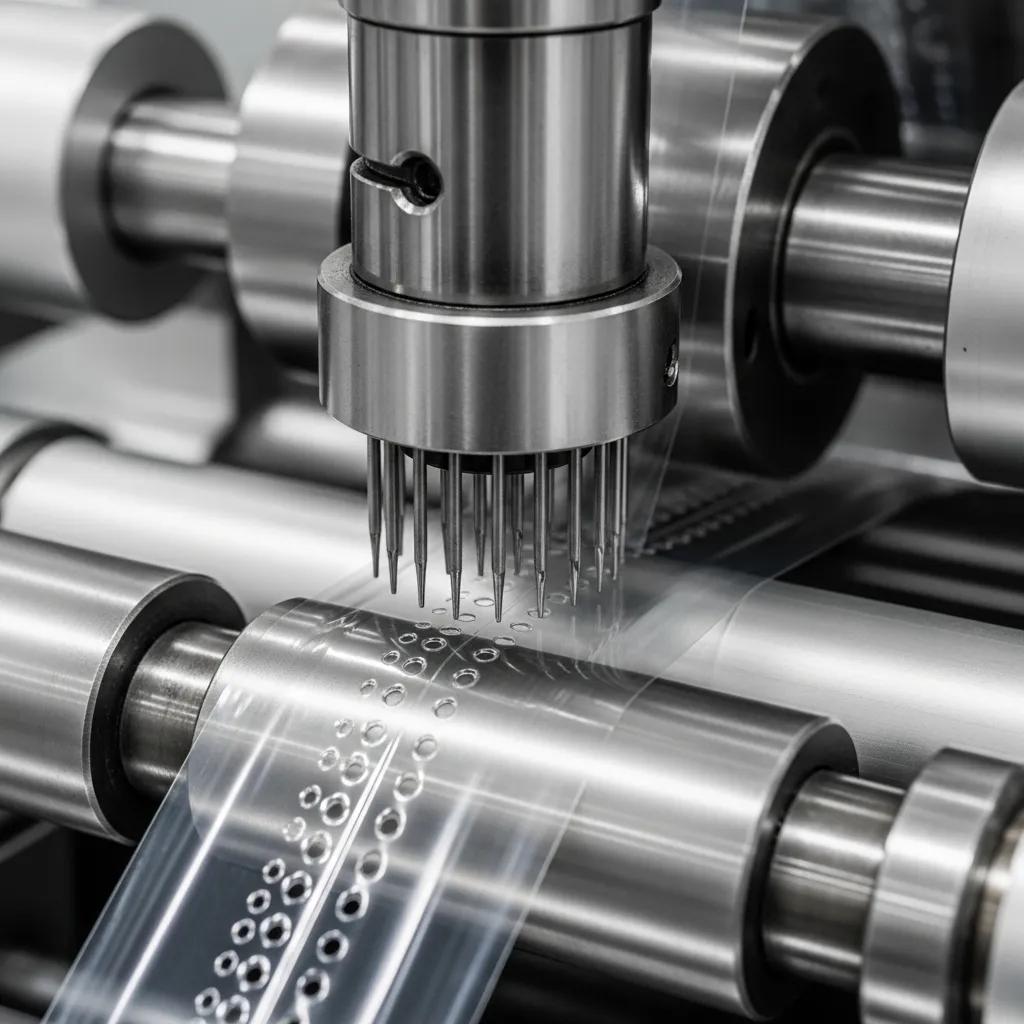
Perforation units add tear lines or micro-perforations to the web to enable easy bag separation and controlled dispensing from a roll. Roller punch units create consistent mechanical perforations, while laser or die-cut systems allow fine control over pitch and tear profile for produce or retail bags. Common spacing guidelines range from short pitches (for single-use trash bags) to longer pitches for produce or carrier rolls; correct pitch and perforation depth prevent premature tearing while ensuring user convenience. Proper perforation design balances film strength, user handling, and machine compatibility to avoid jams and maintain throughput.
High-speed automatic perforated bag machines combine precise motion control, print-registration accuracy, robust sealing, and reliable winding to maintain continuous production with minimal waste. Core features include servo-driven feeding for exact bag length control, photocell sensors for printed film registration and accurate cutting/perforation alignment, automatic tension control and winding systems for stable roll formation, and modular sealing units adaptable to different film gauges. These components work together to reduce stoppages, maintain bag uniformity, and support multi-lane production or integrated printing.
This section highlights the most impactful features for performance and reliability.
These features collectively lower scrap, improve first-pass yield, and support predictable output for production planning. Next, we explain how servo and sensor systems deliver measurable benefits and what to consider for maintenance and retrofits.
Servo motors provide closed-loop control over film feed and positioning, enabling repeatable bag lengths and precise timing for perforation and cutting. Photocell sensors detect printed registration marks and trigger cutting or perforation at exact locations, which is essential when combining flexo printing with perforated roll output. Together these components reduce film waste, minimize miscuts, and enable faster set-up for runs with variable bag lengths. Regular calibration of photocells and preventative maintenance on servo drives preserve accuracy and uptime, making these systems attractive investments for manufacturers aiming to maximize throughput.
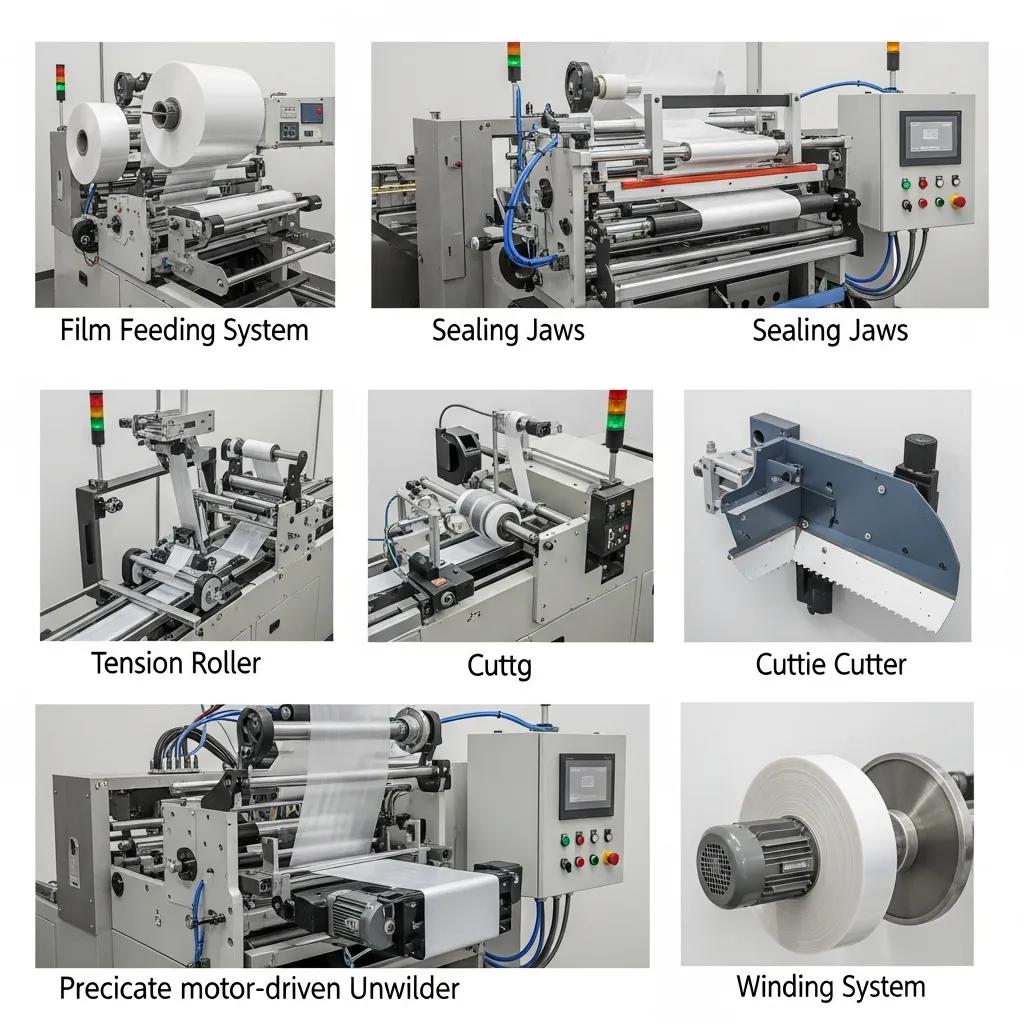
A typical automation chain includes film unwind and tension control, servo-driven feed rollers, sealing jaws or bottom-seal assemblies, perforation units, longitudinal and cross-cutting stations where applicable, and a winding system for core or coreless rolls. Each component contributes to product quality: feed accuracy determines bag length tolerance, sealing temperature and dwell affect seal integrity, perforation knife geometry controls tear behavior, and winding torque impacts roll density. The table below summarizes component roles and production benefits.
| Component | Role | Benefit/Impact on Production |
|---|---|---|
| Servo-driven feed | Controls film advance and bag length | Precise lengths, reduced scrap, rapid changeovers |
| Photocell/registration | Aligns operations to printed patterns | Lower reject rates, accurate perforation/cut |
| Sealing jaws/assemblies | Create bag bottoms/side seals | Reliable seal strength across film gauges |
| Perforation unit | Punches/slots the web at pitch | Controlled tearing, user convenience |
| Winding system (core/coreless) | Collects finished bags | Stable rolls, higher roll capacity, easier dispensing |
This modular architecture supports upgrades and spare-part stocking to minimize downtime. The subsequent section outlines the commercial benefits manufacturers can expect when implementing automated perforated roll production.
Adopting efficient perforated roll bag machines yields direct operational advantages: higher throughput per shift, lower labour input per produced bag, improved first-pass quality, and predictable total cost of ownership. Automated lines convert raw film into finished rolls with consistent perforation and seal quality, which reduces returns and increases customer satisfaction for retailers and bulk buyers. For South African manufacturers competing on cost and delivery reliability, these gains translate into stronger margins and improved capacity to serve cities such as Johannesburg and Cape Town.
These commercial advantages lead naturally to improved ROI calculations and purchasing criteria; the next paragraphs quantify labor and cost impacts and offer an ROI checklist for procurement teams.
Automation replaces repetitive manual steps—film alignment, bag separation, roll winding—and consolidates control into PLC/HMI interfaces that operators can manage with limited staff. Typical workflows see a single operator oversee several machines with automated feeding and winding, cutting labor hours per produced roll. Reduced manual intervention also decreases error rates during changeovers and minimizes downtime from handling-related faults. Planning for staff retraining and implementing safety interlocks ensures a smooth transition to automated workflows and preserves continuous production.
When assessing total cost of ownership, consider energy consumption, maintenance intervals, spare-part availability, and warranty coverage alongside capital cost. Competitive pricing combined with strong R&D and fast delivery shortens lead time to production, improving payback timelines. Use a simple ROI checklist to evaluate offers: required throughput, expected uptime, spare parts lead times, warranty scope, and local service capacity. These variables determine the realistic payback period and ongoing operational expense for each purchase option.
Perforated roll bag machines are compatible with common polyethylene films—HDPE, LDPE, and LLDPE—as well as some recycled blends and compostable resins if processing parameters are adapted. Each resin class has trade-offs in strength, stiffness, and elongation that affect perforation behavior and sealing. Selecting the correct film gauge and adjusting sealing temperatures, perforation depth, and winding tension are essential to produce durable yet user-friendly perforated rolls. A comparative table helps specify film selection for different bag types and perforation profiles.
| Film Type | Key Property | Recommended Gauge (µm) | Suitability for Perforation |
|---|---|---|---|
| HDPE | High stiffness and tear resistance | 12–40 | Good for heavy refuse bags; perforation requires stronger punch depth |
| LDPE | High elongation, flexible seals | 15–60 | Well-suited for star-seal bags and produce; perforation holds well with controlled depth |
| LLDPE | Balanced strength and flexibility | 15–50 | Versatile for both produce and trash rolls with consistent perforation |
HDPE films deliver stiffness and puncture resistance that benefit heavy-duty refuse bags but require more robust sealing force and deeper perforation to ensure reliable tearing. LDPE offers softer, more elastic films that form strong heat seals and accept finer perforations for produce bags. LLDPE provides a balance, often preferred for mixed-use rolls where tear resistance and flexibility are both important. Processing tips include adjusting sealing temperature for film crystallinity, reducing line speed for thicker recycled blends, and testing perforation punch geometry to prevent premature tear propagation.
Recycled and biodegradable films can be processed on most modern roll bag machines but often need slower line speeds, tighter temperature control, and more frequent process checks to manage variability. Compostable resins may have lower melt strength and different sealing windows; manufacturers should work closely with resin suppliers and perform trial runs to validate perforation pitch and seal integrity. Sustainability choices reduce environmental impact and appeal to eco-conscious buyers, but balancing cost, performance, and certification requirements is essential for reliable production.
Plastic Bag Machine South Africa operates under Kingdom Machinery Co., Ltd. and supplies plastic bag production lines in South Africa. The company offers blown film extrusion machines, plastic bag making machines (including garbage bag manufacturing / roll bag production with perforation), flexo printing machines, and plastic recycling machines. Emphasized strengths in the SERP report: simple operation, perfect performance, easy maintenance, timely after-sales service; targets businesses and manufacturers in South African cities including Johannesburg, Cape Town, Gqeberha, and Soweto. Primary product aligning with topic: Garbage Bag Manufacturing Machine and general Plastic Bag Making Machine offerings that can produce perforated bags on a roll. UVPs listed in the SERP: competitive pricing, strong R&D, one-stop service model, robust production capacity, fast delivery, and a two-year warranty on timer switches.
These buyer checks bridge technical needs to procurement decisions; next we present a compact EAV table comparing representative machine models to help shortlist equipment.
| Model | Max Speed (bags/min) | Film Thickness Range (µm) | Power | Automation Level | Typical Applications |
|---|---|---|---|---|---|
| Model A (Coreless) | 60 | 12–40 | 7.5 kW | High (servo/PLC) | Thin-film trash, produce rolls |
| Model B (Star-seal) | 80 | 15–50 | 9.0 kW | High (photocell reg.) | Printed bags, multi-lane output |
| Model C (Bottom-seal) | 45 | 25–80 | 11 kW | Medium | Heavy-duty refuse bags |
This comparison clarifies which architectures align with production targets; after selecting a shortlist, consider integration with blown film extrusion or flexo printing to create a turnkey line. The following brief list outlines integration benefits.
Local service coverage typically includes installation support, commissioning, basic operator training, and spare-part supply planning. Warranty terms vary by component; notable coverage like a two-year warranty on timer switches increases confidence in electrical controls while routine maintenance contracts protect uptime. For buyers, request a clear service plan covering remote diagnostics, spare-part lead times, and recommended spare-part kits to minimize production interruptions. Knowing regional service options ensures machines remain productive and meets delivery commitments to customers.
Manufacturers often request customization such as variable perforation pitch, print registration for branded rolls, alternate winding configurations, or retrofit modules for existing lines. Documenting each case study with a simple template—client need → solution delivered → results (throughput, quality, payback)—helps procurement teams evaluate expected outcomes. Common metrics to capture include increased throughput percentage, labor hours saved, and estimated payback period; these metrics guide informed purchasing decisions and ongoing process improvements.
Below are concise answers to frequent buyer questions that help capture purchase intent and assist evaluation teams in selecting the right machine.
These short answers summarize procurement priorities; fuller explanations follow to guide technical and commercial discussions.
A perforated bag making machine is a converting system that transforms film into pre-cut or perforated bags on a roll by combining film feeding, sealing, perforation, cutting, and winding operations. Typical process steps are: (1) unwind and tension the film, (2) register printed designs if present, (3) seal the bag bottoms or side seams, (4) apply perforations at set pitch, and (5) wind finished bags into core or coreless rolls. This sequence produces consistent, user-friendly rolls for refuse, produce, or retail use, and it is especially effective when synchronized by servo and photocell systems that ensure repeatability.
Production capacity varies by machine architecture, film type, and bag size; manufacturers should evaluate capacity in bands—low (for small-batch or specialty rolls), medium (standard converting lines), and high (multi-lane or fastest star-seal configurations). Key variables that influence capacity include film gauge, perforation complexity, print registration needs, and winding method. To size a machine, assess peak and average demand, allow margin for maintenance downtime, and consider future growth to avoid early obsolescence. Matching line throughput to downstream packing and logistics ensures the selected machine delivers intended commercial value.
Plastic Bag Machine South Africa operates under Kingdom Machinery Co., Ltd. and supplies plastic bag production lines in South Africa. The company offers blown film extrusion machines, plastic bag making machines (including garbage bag manufacturing / roll bag production with perforation), flexo printing machines, and plastic recycling machines. Emphasized strengths in the SERP report: simple operation, perfect performance, easy maintenance, timely after-sales service; targets businesses and manufacturers in South African cities including Johannesburg, Cape Town, Gqeberha, and Soweto. Primary product aligning with topic: Garbage Bag Manufacturing Machine and general Plastic Bag Making Machine offerings that can produce perforated bags on a roll. UVPs listed in the SERP: competitive pricing, strong R&D, one-stop service model, robust production capacity, fast delivery, and a two-year warranty on timer switches.
Plastic Bag Making M
Plastic Recycling So
Plastic Recycling So
Plastic Recycling So